Aug 06 , 2026
Okay, quick answer first: when kidney function drops, your body basically stops flushing out waste and extra fluid properly, and that's usually the moment a doctor starts talking about low kidney function treatment. That's it. That's the headline. Everything else in this post is just me unpacking what that actually means for you, day to day, because "your filtration rate is low" sounds scary but doesn't actually tell you anything useful.
I'll be honest, I didn't know what my kidneys did until a relative got diagnosed with stage 3 CKD and I spent a weekend down a research rabbit hole. Turns out these two little organs sitting near your lower back are doing a LOT more than I gave them credit for. Filtering blood, yes, but also managing blood pressure, keeping your bones from turning brittle, and helping your body make red blood cells. Busy little guys.
📞 Get a Kidney Health Consultation – Call Now!
Here's the thing: it's rarely dramatic. No alarm bells, no sudden collapse (unless there's an injury or infection involved, which is a different story). It's more like your phone battery. Remember when it used to last all day, and now you're plugging it in by 2 pm, and you're not even sure why? That's what declining renal function feels like from the inside: a slow fade that you only notice once it's already gone a while.
Doctors track this with a blood test called eGFR. The number drops as function drops. Simple in theory, less simple when you're the one waiting for results.
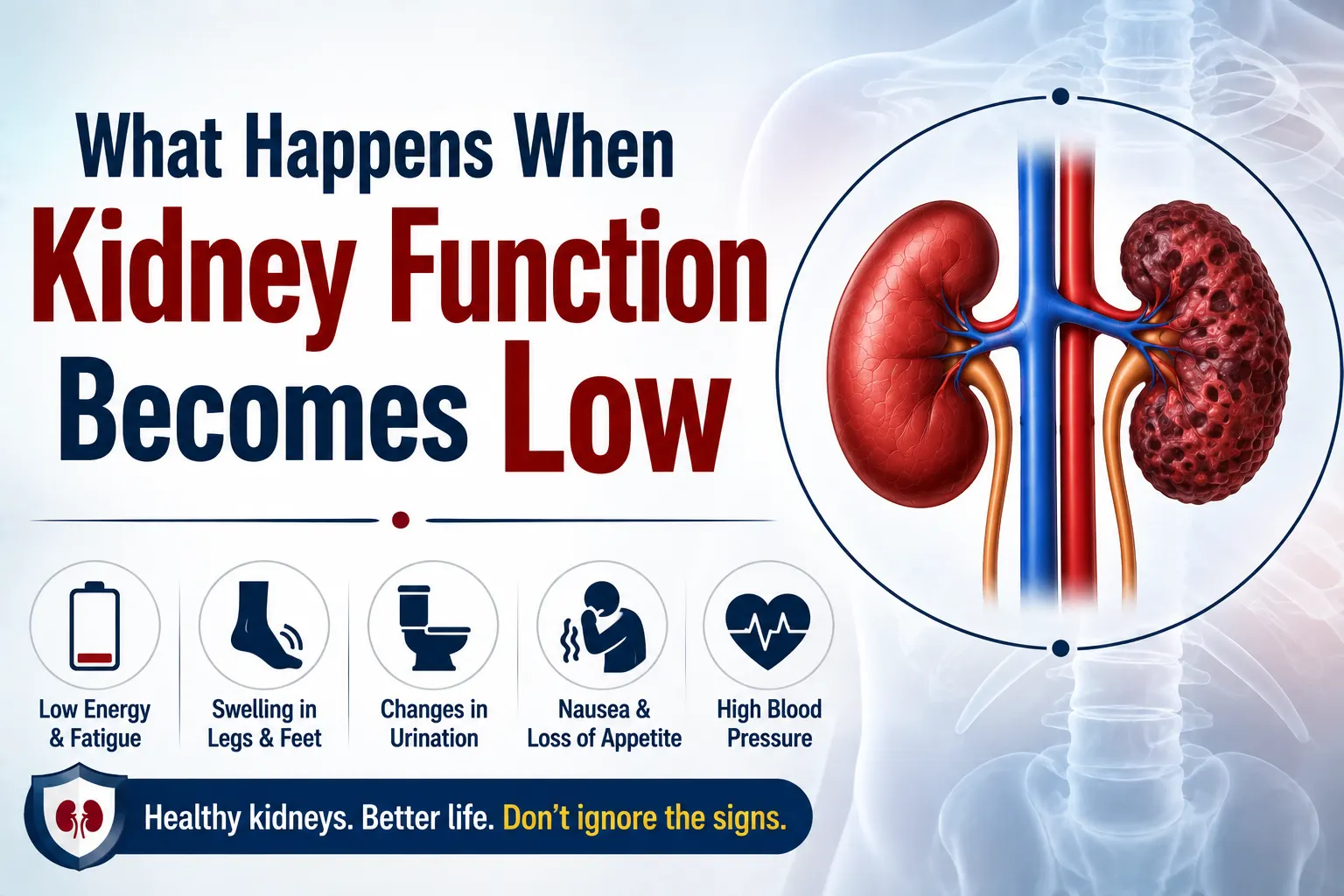
Being tired constantly, even after actual sleep
Puffy ankles or under-eyes; like you retained a swimming pool overnight
Urine that's foamy, or weirdly dark
Food tasting kind of bland or off
That foggy, can't-quite-think-straight feeling
A 2020 paper in The Lancet pointed out that chronic kidney disease affects close to 700 million people globally, and a huge portion don't know until things are already fairly advanced. Kidneys apparently don't like making a scene until it's serious.
This part surprised me most. Since kidneys control blood pressure and bone health too, a decline doesn't stay in its lane. Your heart, your bones, your energy; all of it gets dragged in. So when someone talks about kidney care, they're not being dramatic or overly cautious. It genuinely is whole-body stuff, not a side quest.
📞 Get a Kidney Health Consultation – Call Now!
|
Stage |
What it feels like |
What usually helps |
|
Early |
Tired, but you blame your sleep schedule |
Diet changes, drinking water like it's your job, regular checkups |
|
Moderate |
Ankles that don't look like yours |
Blood pressure meds, tighter monitoring |
|
Advanced |
Running on 2% battery, permanently |
Structured kidney function treatment, specialist involved |
|
Severe |
Kidneys have basically clocked out |
Dialysis or transplant conversations |
Not a perfect science, obviously; everyone's body reacts differently; but this is roughly the arc.
📞 Get a Kidney Health Consultation – Call Now!
Here's the part nobody tells you upfront: for early and moderate stages, treatment is mostly unglamorous habit stuff. Cutting salt. Actually managing blood sugar instead of ignoring it. Drinking enough water, but not chugging it like you're training for something. And ditching painkillers that are basically villains for your kidneys; NSAIDs, I'm looking directly at you.
There's a study in the American Journal of Kidney Diseases that found patients who got serious about blood pressure and blood sugar control early on slowed their kidney decline noticeably. Which, honestly, is kind of reassuring; small, tedious habits actually do something.
If things move past that stage, medication that protects kidney tissue comes in, and eventually dialysis or transplant becomes part of the conversation. This is also the point where you stop trying to piece things together from forums and actually go see a kidney disease doctor. I say this with love; Reddit is not a nephrologist.
Swelling that doesn't disappear even after a full night's sleep
Fatigue that feels different, not just "I stayed up too late again"
Blood pressure that keeps climbing no matter what you try
Urine changes that stick around for more than a day or two
Getting kidney disease help at this point isn't overreacting. It's just... practical. Kidneys tend to forgive you if you catch things early. They're a lot less forgiving if you don't.
Kidney decline is usually gradual; a slow leak, not a sudden break
Fatigue, swelling, and foamy urine are the early red flags most people miss
Renal function is tracked through blood tests, not guesswork or vibes
Diet, hydration, and blood pressure control form the backbone of early treatment
Advanced cases may involve dialysis or transplant, guided by a specialist, not Google
📞 Get a Kidney Health Consultation – Call Now!
Early declines can often improve with lifestyle changes, but more advanced damage usually gets managed rather than fully reversed.
Not always; high blood pressure, infections, and genetics can all play a role too.
Not necessarily; dialysis usually comes into play in advanced or severe stages, not mild ones.
Diet helps a lot, but it works best paired with actual medical guidance, not as a solo fix.
If you've got risk factors like diabetes or high blood pressure, once a year is a pretty reasonable habit.
Disclaimer: This post is written for general understanding, not as medical advice. Kidney health looks different for everyone, and treatment decisions should always involve a qualified healthcare provider, not a blog, however well-intentioned.