Jun 29 , 2026
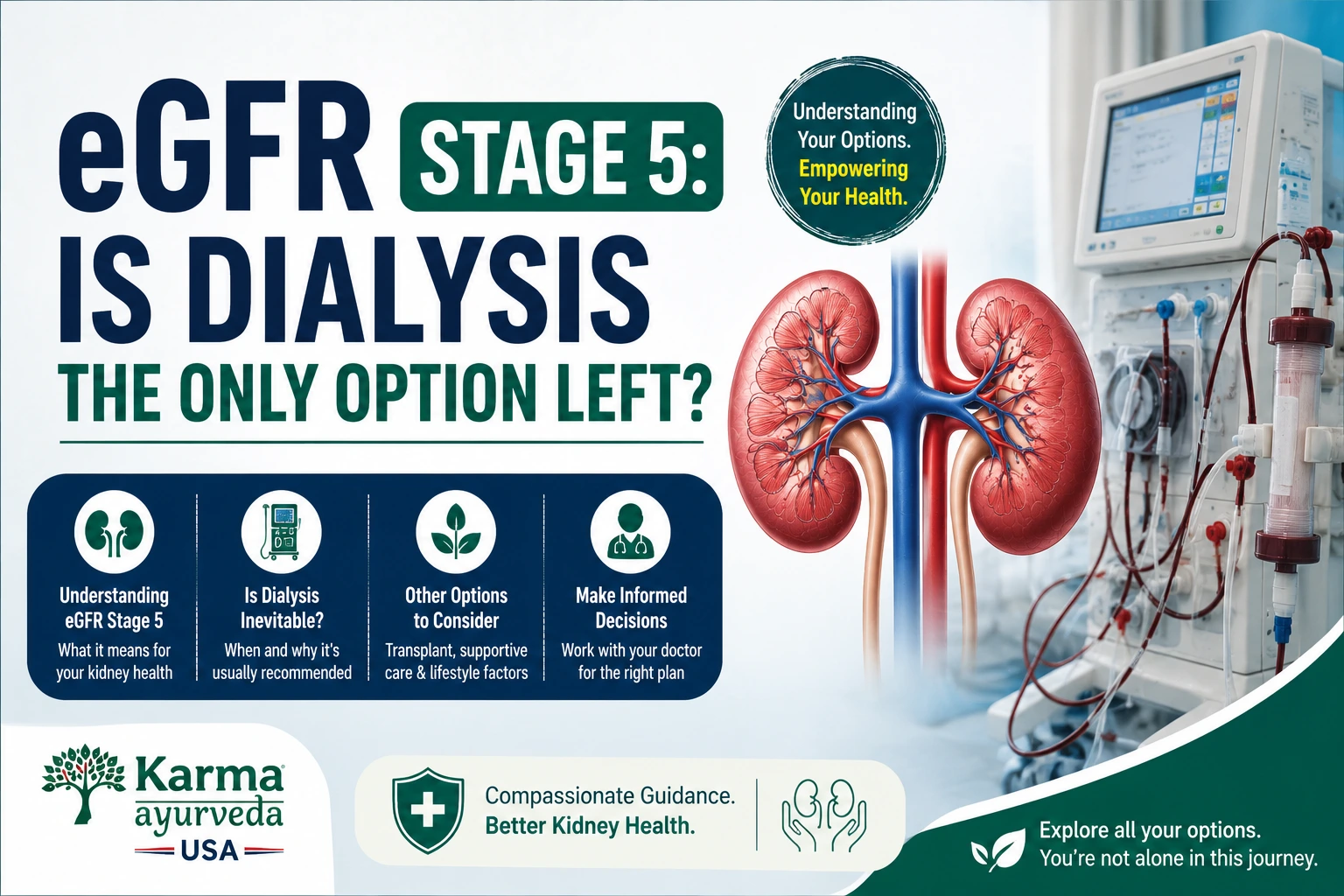
Let's cut straight to it; if you or someone you love has just been told their eGFR stage 5 results, the first question that pops into everyone's head is: "Does this mean dialysis is the next stop?" The short answer? Not necessarily. The longer answer, which is what this article is about, is that it depends on a whole lot of factors, and there's more room for conversation with your doctor than most people realize.
Now, before we get into the good stuff, a small disclaimer: this blog is for information only. We're not doctors, and nothing here should replace actual medical advice from your nephrologist. Think of us as a well-read friend who did their homework.
📞 Get a Kidney Health Consultation – Call Now!
eGFR stands for estimated Glomerular Filtration Rate; basically, it's a number that tells you how well your kidneys are filtering waste from your blood. The kidneys, those two fist-sized organs chilling near your lower back, are filtering about 200 liters of blood every single day. When that filtering capacity drops below 15 mL/min/1.73m², you've entered eGFR stage 5, also called end-stage renal disease (ESRD).
Here's a quick breakdown of the eGFR stages so you know where Stage 5 sits in the bigger picture:
|
eGFR Stage |
eGFR Range (mL/min/1.73m²) |
What It Means |
Typical Approach |
|---|---|---|---|
|
Stage 1 |
90 or above |
Normal kidney function, with signs of damage |
Monitoring, lifestyle changes |
|
Stage 2 |
60–89 |
Mildly reduced function |
Diet, blood pressure control |
|
Stage 3a/3b |
30–59 |
Moderate reduction |
Medications, closer monitoring |
|
Stage 4 |
15–29 |
Severely reduced |
Preparation for possible RRT |
|
Stage 5 |
Below 15 |
Kidney failure |
Dialysis, transplant, or conservative care |
As you can see, stage 5 kidney disease doesn't automatically mean you're wheeled off to a dialysis chair the very next morning. There are options; some more aggressive, some more conservative.
📞 Get a Kidney Health Consultation – Call Now!
If you're wondering how someone ends up here, the low eGFR causes are often a slow-burning story. The most common culprits include:
Diabetes (diabetic nephropathy is responsible for roughly 40% of ESRD cases globally)
Chronic high blood pressure damages the tiny kidney blood vessels over time
Glomerulonephritis: inflammation of the kidney's filtering units
Polycystic kidney disease (the genetic kind)
Long-term use of certain painkillers or other nephrotoxic medications
Recurrent kidney infections or urinary tract obstructions
A study published in 2020 by Kovesdy CP, titled "Epidemiology of Chronic Kidney Disease: An Update 2022" (conducted through large population-based cohort studies), highlighted that diabetes and hypertension together account for the vast majority of CKD progression to Stage 5 worldwide.
Here's the question everyone Googles at 2 AM: Is dialysis mandatory for stage 5 kidney disease? And the honest answer is: no, it isn't always mandatory, but it is often necessary when symptoms become life-threatening.
Dialysis does the job your kidneys can no longer do on their own. It filters your blood, removes excess fluid, and keeps your electrolytes from going haywire. Without it, or a transplant, when kidneys truly fail, the body starts accumulating toxins. That's not a situation anyone wants.
However, for some patients, particularly older adults with multiple health conditions, conservative (non-dialysis) management is a legitimate, physician-guided option. This isn't giving up; it's choosing quality of life over quantity of hospital visits.
A landmark study by Verberne WR et al. (2016), "Comparative Survival Among Older Adults with Advanced Kidney Disease Managed Conservatively Versus with Dialysis", found that for elderly patients over 75 with multiple comorbidities, survival differences between dialysis and conservative management were smaller than expected, and quality of life factors were significant.
📞 Get a Kidney Health Consultation – Call Now!
The treatment options for eGFR below 15 broadly fall into three categories:
1. Hemodialysis. This is the one most people picture: sitting in a clinic three times a week while a machine filters your blood. It typically takes 3–5 hours per session. It's effective, but it does demand a significant chunk of your week.
2. Peritoneal Dialysis (PD) This one uses the lining of your abdomen as a natural filter. You fill your belly with a special fluid, let it sit, and drain it out; all from home. More flexible, more independent. Not suitable for everyone, but worth discussing with your nephrologist.
3. Kidney Transplant: The gold standard, honestly. A functioning donor kidney can restore near-normal kidney function and dramatically improve quality of life. The catch? Waiting lists can be long, and not everyone is a candidate.
4. Conservative Kidney Management (CKM) For patients who are not candidates for dialysis or transplant, or who choose not to pursue them, conservative management focuses on symptom control, diet, medications, and palliative support. It's a valid, dignified path that deserves more open conversation than it gets.
A study by O'Connor NR et al. (2012), "Survival in Dialysis vs. Conservative Management", published in the Journal of Pain and Symptom Management, noted that conservative management was associated with better symptom burden outcomes for frail elderly patients with ESRD.
This one comes up a lot, and rightfully so. Can stage 5 kidney disease be managed without dialysis? Yes, but with important caveats.
Some patients in Stage 5 have what's called a "honeymoon period" where their residual kidney function is just enough to keep symptoms manageable, particularly if they follow a strict low-protein, low-potassium, low-phosphorus diet and keep blood pressure and fluid intake tightly controlled.
This is not a long-term fix; it's a bridge, not a destination. But it does mean that with the right medical team and genuine lifestyle discipline, some patients can delay the start of dialysis for months, sometimes longer.
Kalantar-Zadeh K et al. (2017), in a major review called "Plant-Dominant Low-Protein Diet for Conservative Management of Chronic Kidney Disease", explored how structured dietary intervention could slow progression and support kidney function at very low eGFR levels.
That said, do not try to manage this alone. Electrolyte imbalances at Stage 5 can be dangerous and fast-moving.
📞 Get a Kidney Health Consultation – Call Now!
For anyone navigating stage 5 CKD management, the day-to-day reality tends to involve a combination of:
Regular lab work (sometimes weekly) to monitor potassium, phosphorus, bicarbonate, and creatinine
Blood pressure medications, ACE inhibitors or ARBs, are commonly prescribed
Phosphate binders to keep phosphorus in check (your kidneys aren't removing it well anymore)
Erythropoiesis-stimulating agents or iron therapy for the anemia that often accompanies Stage 5
A carefully structured renal diet: reduced protein, limited potassium and phosphorus, fluid restrictions
Monitoring for uremic symptoms: fatigue, nausea, confusion, itching, and swelling
The kidney failure treatment landscape has genuinely evolved. Newer medications like SGLT2 inhibitors have shown promise even in late-stage CKD. Perkovic V et al. (2019) published the landmark CREDENCE Trial, a randomized controlled trial, showing significant kidney-protective benefits of canagliflozin in CKD patients with diabetes.
The conversation around Stage 5 can feel clinical and cold. It doesn't have to be. Here's what's worth keeping in mind:
Starting dialysis is not "losing"; it's a tool, and for many people, it allows them to live well for years or even decades.
Not starting dialysis is not "giving up"; for some patients, it's the most thoughtful and humane choice.
A second opinion is always okay. Always.
Palliative care alongside CKD care is not only allowed; it's recommended by most nephrology guidelines.
Living donor transplants from family or friends significantly reduce waiting times and improve outcomes.
eGFR stage 5 is serious, and we're not going to sugarcoat that. But it is not a one-size-fits-all diagnosis with one scripted outcome. The path forward depends on your age, your other health conditions, your support system, what matters most to you, and a good, honest conversation with a nephrologist who actually listens.
Dialysis is often part of the picture at eGFR stage 5, but it is not the only brushstroke. The painting looks different for everyone.
📞 Get a Kidney Health Consultation – Call Now!
No, dialysis is not mandatory, as patients can choose comprehensive conservative management or a kidney transplant instead.
Yes, it can be actively managed without dialysis through specialized medications, strict blood pressure control, and targeted renal diets.
The three main choices are hemodialysis or peritoneal dialysis, a kidney transplant, or comprehensive conservative medical care.
The most common causes of low eGFR are long-term high blood pressure, diabetes, and autoimmune kidney diseases.
It focuses on preserving remaining kidney function, controlling symptoms like fatigue and nausea, and maintaining your overall quality of life.