Aug 27 , 2026
Kidney disease alters your body's fluid balance because damaged kidneys lose their ability to filter out excess water and sodium, leaving the fluid with nowhere to go but to leak into your surrounding tissues. When the internal plumbing breaks down, you start looking and feeling like a water balloon that is filled to its maximum capacity.
Think of your kidneys as your body's ultimate bouncers. In a perfectly healthy system, they stand at the door of your bloodstream, deciding exactly how much water gets to stay and how much gets kicked out into the bladder. They process roughly 150 quarts of blood every single day just to keep things moving smoothly. But when things go south and a person faces the prospect of chronic kidney failure, those bouncers essentially take an unannounced, indefinite coffee break. Without them on the job, the fluid just piles up at the entrance.
📩 Ask a Kidney Expert (Free 10-Min Consultation)
To understand why this happens, it helps to look at the microscopic filters inside your kidneys, called nephrons. When these structures are damaged, the entire system stalls.
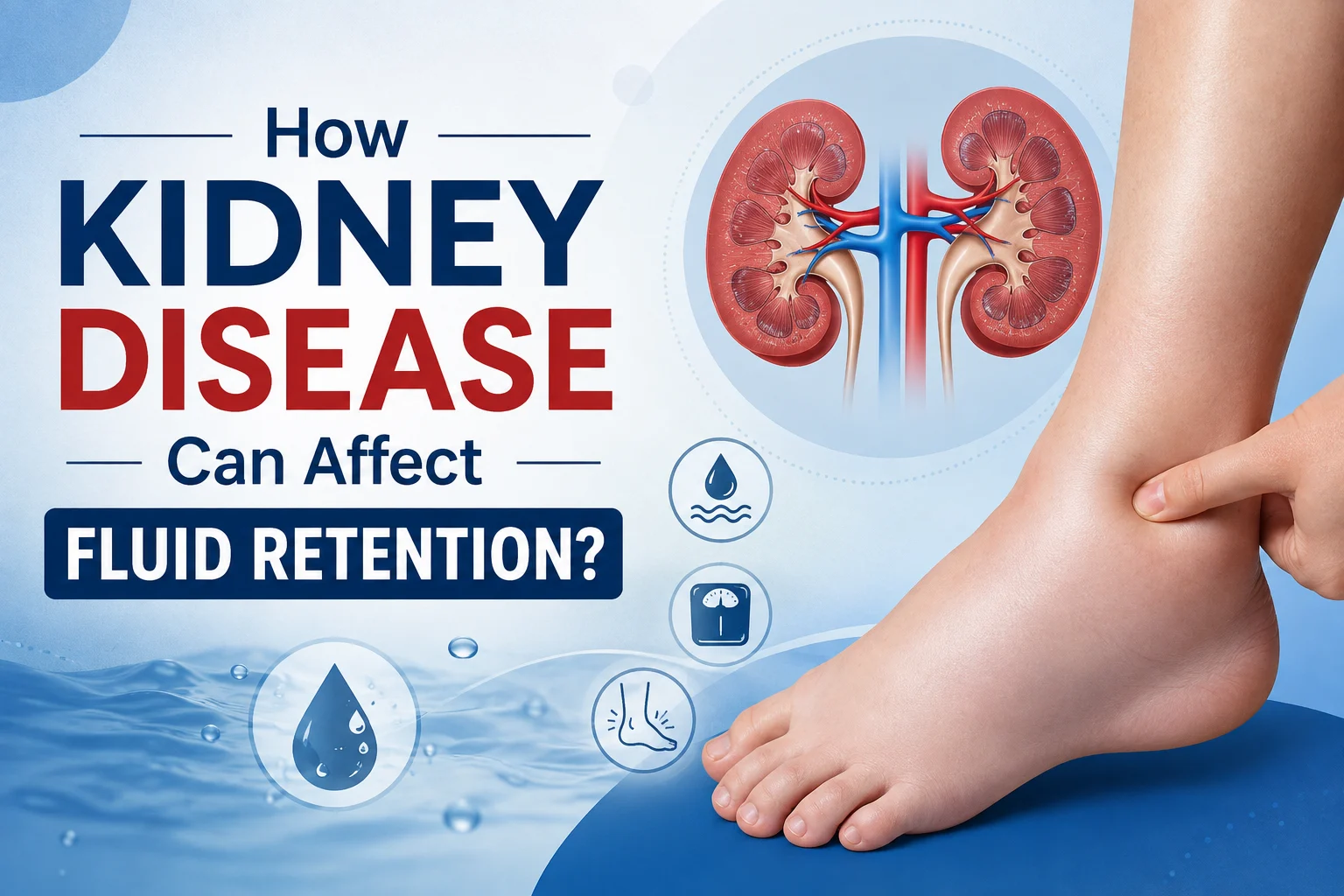
When your renal function drops, it isn't just an internal statistical problem; it becomes a highly visible, physical one. The extra fluid has to park somewhere. Usually, gravity pulls it straight down to your ankles and feet, but it can also set up camp in your hands or right under your eyes, leaving you looking like you went ten rounds in a boxing ring overnight.
Medical folks call this buildup edema, but to the average kidney disease patient, it just feels like your favorite shoes suddenly shrank three sizes by lunchtime.
There is a simple test doctors use to tell the difference between typical weight gain and true fluid retention. They press a thumb into the swollen area for a few seconds. If the dimple stays there like a footprint in memory foam after they let go, that is "pitting" swelling; a classic sign that your body is holding onto way too much water.
Let's look at how everyday life differs when your kidneys are firing on all cylinders versus when they are struggling.
|
The Situation |
Healthy Kidneys |
Struggling Kidneys (kidney failure chronic) |
|
Eating a salty meal |
You get thirsty, drink water, pee it out, and carry on. |
The salt acts like a sponge, locking fluid inside your tissues. |
|
Looking in the mirror |
Normal face, maybe a little sleepy. |
Puffiness under the eyes that doesn't care how much you slept. |
|
Putting on socks |
Fits perfectly fine. |
Deep, stubborn elastic ring marks left around your ankles. |
|
Stepping on the scale |
Weight moves by ounces. |
Unexplained jumps of two to three pounds in a single day. |
📞 Get a Kidney Health Consultation – Call Now!
This isn't a random glitch; it is a mechanical failure. A major clinical review published in The New England Journal of Medicine (titled Mechanisms of Fluid Retention in Kidney Disease) highlighted that damaged kidneys trigger a faulty hormonal loop. The body mistakenly thinks it is dehydrated because the fluid isn't sitting in the right places, so it releases signals to hold onto even more salt and water. It is a terrible case of internal miscommunication.
Furthermore, a study in The Lancet tracking long-term kidney care strategies observed that when the filtration rate falls, the heart has to pump much harder to push this heavier volume of fluid through the body. This extra workload is exactly why uncontrolled fluid retention and kidney disease so frequently go hand-in-hand with high blood pressure.
If you are dealing with this, managing the balance becomes your primary daily job. Doctors frequently prescribe diuretics; affectionately known as water pills; which essentially force the lazy kidney filters to squeeze out the extra fluid.
You also have to keep an incredibly close eye on your sodium intake. Sodium is fluid’s partner-in-crime; where salt goes, water follows. Cutting back on the salt shaker is often the fastest way to stop the relentless buildup before it gets out of hand.
The Core Cause: Decreased kidney function prevents the body from removing extra sodium and water.
The Gravity Effect: Extra fluid pools in the lowest points of the body, leading to heavy, swollen ankles and feet.
The Footprint Test: Pitting edema leaves a temporary dimple when you press your skin, showing the fluid is stuck in the tissue.
The Heart Connection: Excess fluid raises blood pressure, making sodium restriction and fluid monitoring vital.
📩 Ask a Kidney Expert (Free 10-Min Consultation)
Gravity pulls the unfiltered fluid down to your lower limbs while you walk and sit throughout the daytime hours.
Not necessarily, because you must balance fluid intake precisely with your output under a doctor's guidance to avoid dangerous dehydration.
You can easily gain two to three pounds of pure water weight in a single day if your kidneys fail to clear fluids.
It usually starts as a heavy, stretched, uncomfortable sensation, but severe swelling can make the skin tight, shiny, and tender to the touch.
This article is written for educational and entertainment purposes only and does not constitute professional medical advice, diagnosis, or treatment. Always consult with a qualified healthcare provider or nephrologist regarding any questions you have about a medical condition, dietary changes, or changes to your medication routine.