Jul 21 , 2026
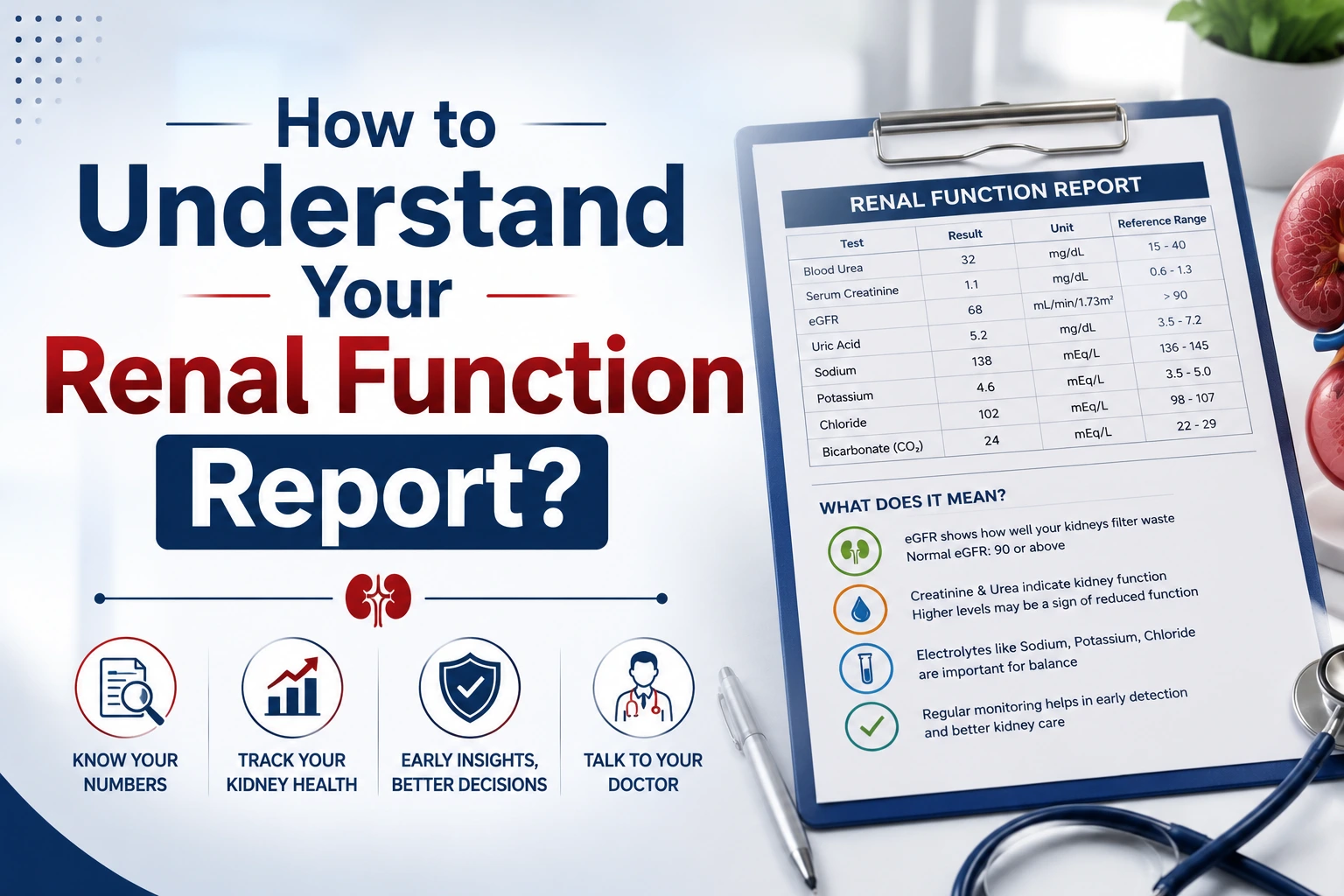
Your renal function report is basically your kidneys' report card, and yes, you can read it without a stethoscope or a decade of med school. It looks like a wall of numbers and abbreviations designed to induce panic, but once you know what a handful of terms mean, it's actually pretty simple.
Let's be honest, most of us fold our lab reports the second we get them, nod at the doctor, and pretend we understood every word. No judgment; creatinine and eGFR sound like Wi-Fi router settings, not body parts. But your kidneys filter about 50 gallons of blood every single day, quietly doing the unglamorous job of keeping your body's chemistry in balance. So it's worth five minutes to figure out what they're trying to tell you.
📞 Get a Kidney Health Consultation – Call Now!
Most renal function reports revolve around a few key stars of the show:
Creatinine – A waste product from muscle activity. High levels can mean your kidneys aren't filtering as efficiently as they should.
eGFR (estimated Glomerular Filtration Rate) – Basically your kidney's filtration speed score. Higher is generally better, like Wi-Fi speed, not golf.
BUN (Blood Urea Nitrogen) – Another waste marker; think of it as creatinine's chatty cousin.
Sodium, Potassium, and Electrolytes – These tell you if your kidneys are keeping your body's internal seesaw balanced.
Albumin/Protein in Urine – If protein is leaking into your urine, it could be an early whisper (not yet a shout) that something needs attention.
Here's the thing: a single odd number doesn't mean your kidneys have thrown in the towel. Doctors look at the full pattern over time, not one lonely digit having a bad day.
📞 Get a Kidney Health Consultation – Call Now!
If you're wondering how to read renal function report results at home, start with eGFR. A number above 90 is generally considered normal. Between 60-89 might just mean mild, age-related decline (kidneys age too, just less dramatically than your knees). Anything consistently below 60 for three months or more is when doctors start paying closer attention, since it may point toward chronic kidney disease.
A 2021 study published in The Lancet by the CKD Prognosis Consortium found that eGFR and urine albumin levels together predict kidney-related risks far more reliably than either marker alone, which is exactly why your report includes multiple numbers instead of just one.
📞 Get a Kidney Health Consultation – Call Now!
|
Marker |
Chill Zone |
Keep an Eye On It |
Call Your Doctor |
|
eGFR |
90+ |
60-89 |
Below 60 (persistent) |
|
Creatinine |
0.6–1.3 mg/dL |
Slightly above range |
Significantly elevated |
|
Protein in urine |
None/trace |
Mild, occasional |
Persistent, high levels |
|
Potassium |
3.5–5.0 mEq/L |
Borderline high/low |
Outside range repeatedly |
Think of this table as your kidneys' mood ring; not a diagnosis, just a vibe check before your real conversation with a professional.
📞 Get a Kidney Health Consultation – Call Now!
If your numbers are borderline once, it's usually not an emergency; kidneys can be dramatic for a day due to dehydration, intense workouts, or too much protein shake enthusiasm. But if abnormal results show up repeatedly, it's time to see a kidney disease doctor, ideally a nephrologist, who can order a proper kidney test panel and figure out what's really going on.
This is especially important for CKD monitoring, since chronic kidney disease is sneaky; it rarely shouts, it whispers. According to the National Kidney Foundation, nearly 90% of adults with reduced kidney function don't even know they have it. That's not a typo. Regular testing genuinely is the only reliable way to catch it early.
Good kidney care isn't a one-time event; it's more like maintaining a car; regular checkups prevent small issues from becoming expensive, dramatic ones. If you have diabetes, high blood pressure, or a family history of kidney issues, doctors often recommend more frequent monitoring of your renal function, since these conditions are the leading causes of kidney damage worldwide, per data from the World Health Organization.
If numbers do trend the wrong way, don't panic; modern kidney function treatment options range from simple lifestyle and dietary tweaks to medications that ease the kidneys' workload, and in advanced cases, more specialized interventions. Early detection genuinely changes outcomes here.
📞 Get a Kidney Health Consultation – Call Now!
Your report reflects a pattern over time, not a one-day verdict
eGFR and creatinine are the headline numbers to track
Repeated abnormal results, not a single odd one, warrant a doctor's visit
Regular testing is the best defense since kidney issues often show no symptoms early on
Lifestyle habits; hydration, blood pressure control, balanced diet; genuinely support kidney health
📞 Get a Kidney Health Consultation – Call Now!
Generally, an eGFR above 90 and creatinine within your lab's standard range is considered normal, but your doctor interprets it alongside your health history.
Yes, being dehydrated on test day can temporarily nudge creatinine and BUN levels higher than usual.
Once a year for most healthy adults, and more frequently if you have diabetes, hypertension, or a family history of kidney disease.
Not necessarily; it could be diet, exercise, or medication related, so a repeat test is usually the next step, not panic.
Early-stage damage can often be slowed or partially improved with treatment, though advanced CKD is usually managed rather than reversed.
Disclaimer: This blog is for general informational purposes only and isn't a substitute for professional medical advice, diagnosis, or treatment. Lab values and reference ranges vary by lab and individual health status. Always consult a qualified doctor to interpret your specific renal function report and guide your care.