Jul 23 , 2026
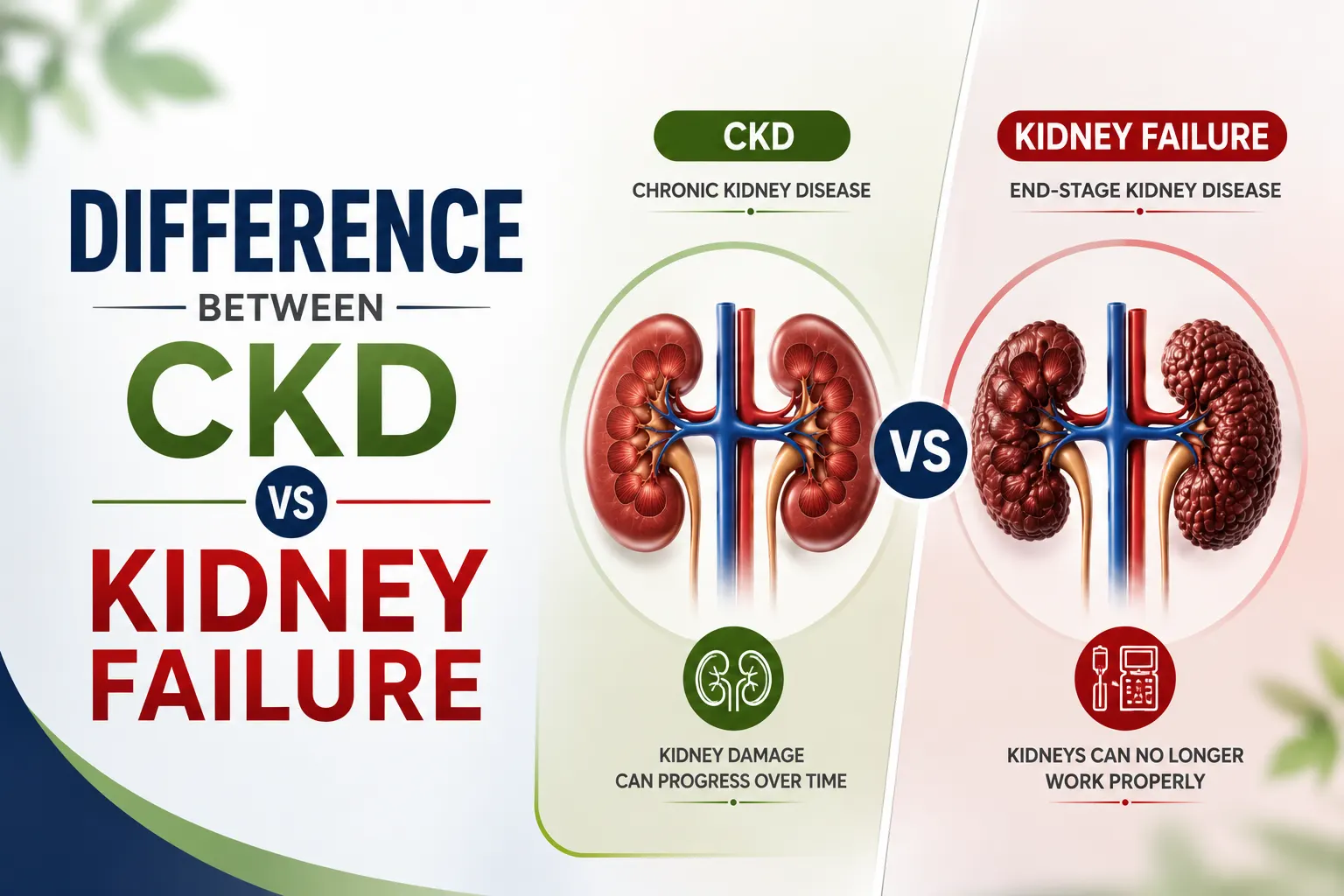
CKD is the slow, sneaky decline of your kidneys over months or years, while kidney failure is the finish line; the point where your kidneys can barely (or can't) do their job without dialysis or a transplant. In other words, one is a long, winding road, and the other is the cliff at the end of it. Grab a cup of tea (your kidneys will thank you if it's not too much caffeine) and let's unpack this properly.
Chronic kidney disease is basically your kidneys throwing in the towel, but very, very slowly; like a marathon runner who's decided to walk the last ten miles instead of sprinting into a wall. Doctors measure this decline using something called eGFR (estimated glomerular filtration rate), which sounds fancy but is really just a way of asking, "Hey kidneys, how much filtering are you actually getting done?"
Stage 1: Kidneys are basically fine on paper, but there are early warning signs like protein in urine.
Stage 2: Mild dip in function; think of it as your kidneys hitting the snooze button.
Stage 3 (a and b): Function drops more noticeably; fatigue and swelling might show up uninvited.
Stage 4: Severe decline; this is when a kidney disease doctor (a nephrologist, if you want to sound fancy at dinner parties) becomes a regular in your life.
Stage 5: Also called end-stage renal disease, and yes, this is essentially kidney failure.
This CKD illness doesn't happen overnight. It's a slow burn, usually caused by long-standing troublemakers like diabetes and high blood pressure. Research published in IEEE on electronic health records notes that CKD affects roughly 13% of the general population worldwide, and it quietly raises the risk of heart disease, anemia, and bone problems long before anyone ends up on dialysis.
📞 Get a Kidney Health Consultation – Call Now!
Kidney failure is what happens when the kidneys stop doing their job well enough to keep you alive without outside help. This is the "we need backup now" stage; dialysis or a transplant enters the chat. Some doctors also call this renal failure, which is just a slightly more textbook-sounding way of saying the same grim thing.
Here's the part people often miss: kidney failure isn't always the end of a slow CKD journey. It can also happen suddenly; think a severe infection, a bad reaction to medication, or major blood loss; a scenario doctors call acute kidney injury. That's a completely different beast from the chronic, years-in-the-making version we're discussing here.
Let's settle the CKD vs kidney failure debate once and for all, because honestly, the confusion is completely understandable; the terms get thrown around like they're interchangeable, and they are absolutely not.
|
Feature |
CKD |
Kidney Failure |
|
Speed |
Slow and sneaky, like a Monday morning |
Can be the final stage of CKD, or come on fast |
|
Stages |
1 through 5 |
Basically "Stage 5, we've arrived" |
|
Symptoms |
Often silent early on (rude, honestly) |
Hard to ignore; fatigue, swelling, nausea, the works |
|
Treatment |
Lifestyle changes, meds, monitoring |
Dialysis or transplant, no shortcuts |
|
Reversible? |
Sometimes manageable, rarely fully reversed |
Requires ongoing medical support to survive |
A study looking at physical performance in older adults with CKD found that people in the kidney failure group had notably weaker grip strength and slower walking speed compared to those in earlier CKD stages; basically, science confirming what common sense already suspected: the further along this illness goes, the more it takes out of you, quite literally.
📩 Ask a Kidney Expert (Free 10-Min Consultation)
Here's the good news buried in all this kidney talk: catching CKD illness in its early stages gives you a genuine shot at slowing it down before it becomes kidney failure. A cross-sectional study on CKD progression even found that certain proteins in the blood shift noticeably as early as Stage 2, suggesting the body starts sending signals well before symptoms show up. Translation: your kidneys are trying to tell you something long before you feel sick.
Good kidney care isn't complicated, even if it sounds intimidating:
Keep blood pressure and blood sugar in check (yes, that means actually taking your meds)
Cut back on excess salt and processed food
Stay hydrated, but don't go overboard chugging water like it's a competitive sport
Get regular blood and urine tests, especially if diabetes or hypertension runs in the family
See a kidney disease doctor if your eGFR or creatinine numbers start looking suspicious
Even research on thyroid function in CKD patients found that hormone levels start drifting as kidney disease progresses through the stages; a good reminder that this isn't just a "kidney problem," it quietly nudges the rest of the body too.
CKD and kidney failure are cousins, not twins. One is the long, gradual decline; the other is the point where the kidneys need outside help to keep the body running. Knowing the difference isn't just trivia; it's the difference between catching a problem early and managing it, versus scrambling once things have already gotten serious.
CKD is a gradual, staged decline in kidney function; kidney failure is the most severe stage, where dialysis or a transplant is needed.
CKD progresses through five stages, tracked mainly through eGFR levels.
Kidney failure can also happen suddenly (acute), which is different from the chronic version.
Early detection and lifestyle changes can meaningfully slow CKD's progression.
Regular checkups with a kidney disease doctor are your best defense against surprises.
📩 Ask a Kidney Expert (Free 10-Min Consultation)
No; CKD is the broader, gradual disease process, and kidney failure is its most advanced stage.
Rarely fully reversed, but early-stage CKD can often be slowed or stabilized with the right lifestyle changes and medication.
Early CKD is often silent, though some people notice fatigue, swelling in the ankles, or changes in urination.
Kidney failure is treated with dialysis or a kidney transplant, since the kidneys can no longer filter blood on their own.
People with diabetes, high blood pressure, or a family history of kidney disease face the highest risk.
Disclaimer: This blog is for general informational purposes only and isn't a substitute for professional medical advice, diagnosis, or treatment. Kidney health can vary a lot from person to person, so please consult a qualified kidney disease doctor for guidance specific to your situation.