Aug 17 , 2026
Wondering what a kidney test actually checks and how often you need one? Short answer: it checks how well your kidneys are filtering waste from your blood, and depending on your health, that could be anywhere from once a year to once a month. Not the most thrilling answer, we know. But stick with us, because once you understand what these numbers actually mean, testing stops feeling like a mystery box and starts feeling like a dashboard you can actually read.
Your kidneys are basically the unpaid, unappreciated interns of your body. They filter roughly 150 quarts of blood a day, quietly show up to work, and never once ask for a raise. The problem is, they're also incredibly good at suffering in silence. You can lose a huge chunk of kidney function before you feel a single symptom. That's exactly why a kidney test isn't just a "nice to have"; it's often the only early warning system you've got.
📞 Get a Kidney Health Consultation – Call Now!
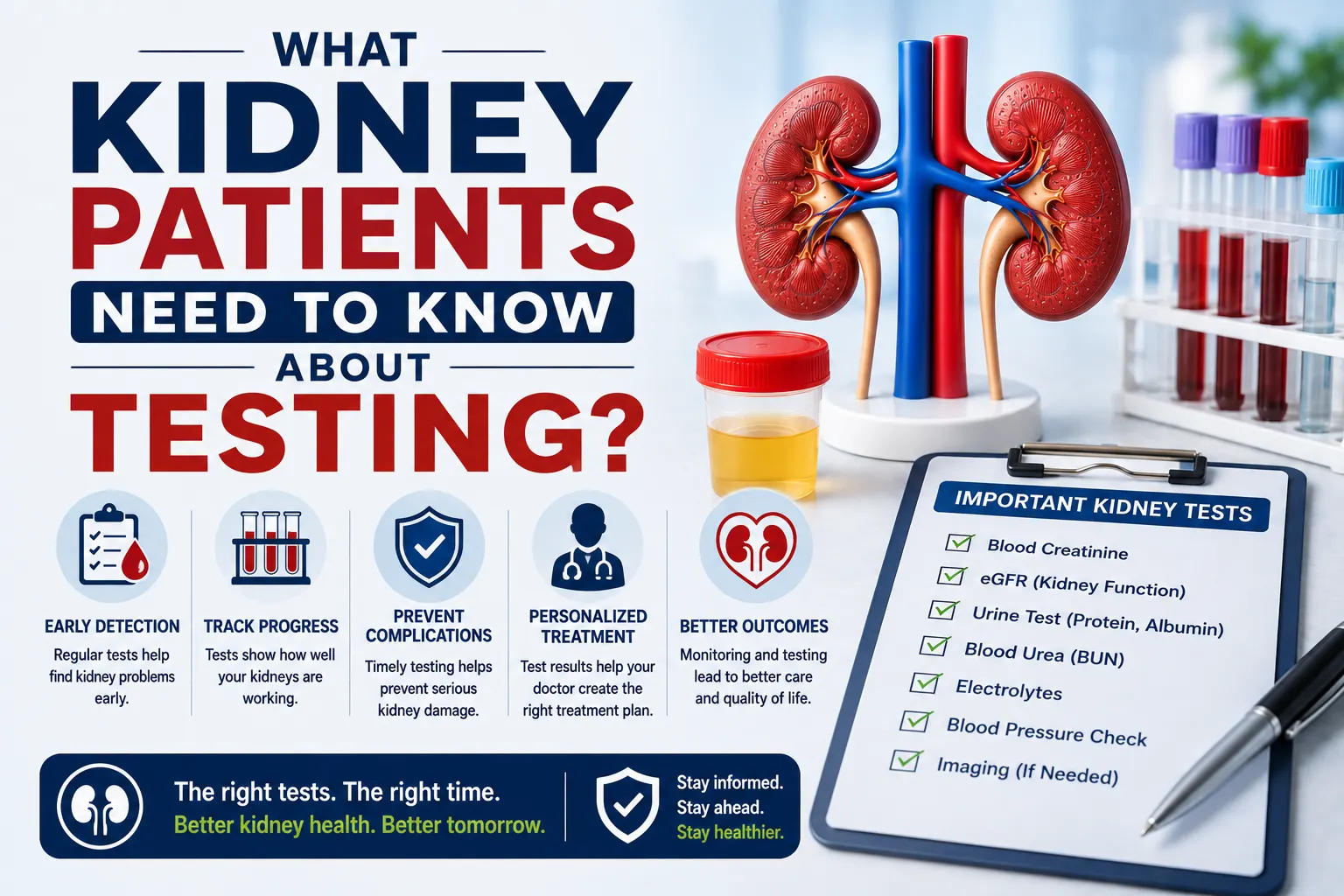
When your doctor orders a kidney test, they're usually looking at a combo of things:
Serum creatinine – a waste product your muscles produce, which healthy kidneys filter out efficiently
eGFR (estimated Glomerular Filtration Rate) – basically a report card grade for your renal function
Urine albumin (ACR test) – checks if protein is leaking into your urine, which it shouldn't be
Electrolytes – sodium, potassium, and friends, since kidneys keep these balanced
The eGFR calculation most labs use today comes from the CKD-EPI equation, developed by Levey and colleagues and published in the Annals of Internal Medicine in 2009. It replaced the older MDRD formula because it was found to estimate kidney function more accurately, especially in people whose kidneys were only mildly affected; the group most likely to be missed otherwise.
📩 Ask a Kidney Expert (Free 10-Min Consultation)
Here's the plot twist nobody tells you: one good result doesn't mean you're in the clear forever. Kidney disease is sneaky and progressive, which is why CKD monitoring matters so much. Think of it less like a single exam and more like checking the weather; yesterday's sunshine doesn't guarantee today's forecast.
The KDIGO (Kidney Disease: Improving Global Outcomes) clinical guidelines, widely followed by nephrologists worldwide, recommend that testing frequency be based on both your eGFR and your urine albumin levels. Translation: the worse your numbers, the more often you should be tested. It's not your doctor being paranoid; it's just math.
|
Your Situation |
How Often to Test |
Basically... |
|
Healthy, no risk factors |
Once during routine checkups |
"Chill, but don't ghost your doctor" |
|
Diabetes or high blood pressure |
At least once a year |
"You're on the watchlist, in a caring way" |
|
Diagnosed CKD (early stage) |
Every 3–6 months |
"We're keeping a closer eye now" |
|
Advanced CKD or on dialysis |
Monthly or more |
"This is basically a subscription service now" |
📞 Get a Kidney Health Consultation – Call Now!
If your test results come back off, or your regular doctor raises an eyebrow at your numbers, that's usually your cue to consult a kidney disease doctor (a nephrologist, if we're being fancy). You don't need to wait until things feel dramatic. Early referral has repeatedly been linked to better long-term outcomes, largely because nephrologists can catch subtle patterns a general physician might not flag immediately.
A 2010 study published in the American Journal of Kidney Diseases by Matsushita and colleagues also found that using more accurate GFR equations changed CKD prevalence estimates and improved risk prediction, meaning better testing tools directly translate to better, earlier decisions.
Get your blood pressure checked regularly; it's basically kidney enemy #1
Stay hydrated, but don't overdo the "detox water" trends
Watch your salt and processed food intake
Don't skip your kidney health testing appointments, even if you feel fine (especially if you feel fine)
Keep a simple log of your eGFR and creatinine numbers over time; patterns matter more than single results
Good kidney care isn't about obsessing over every number. It's about consistency, the same way you'd keep an eye on your car's oil levels instead of waiting for the engine to start smoking.
A kidney test typically checks creatinine, eGFR, and urine protein levels
Kidney disease often has no early symptoms, so testing catches problems before you'd ever feel them
Testing frequency depends on risk factors like diabetes, high blood pressure, or existing CKD
The CKD-EPI equation (Levey et al., 2009) is the standard formula labs use for eGFR
See a kidney disease doctor early if results are abnormal; don't wait for symptoms
At least once a year, though your doctor may suggest more often if your numbers are trending the wrong way.
Yes, especially in early stages, which is why urine albumin testing is done alongside blood tests.
Pretty much; it's a practical estimate of how well your kidneys are filtering, expressed as a number rather than a percentage, but people often use it that way informally.
It's worth a conversation with one, since catching mild changes early tends to lead to better long-term management.
Staying hydrated supports healthy kidney function, but it won't fix an underlying kidney problem on its own.
Disclaimer: This blog is for general informational purposes only and isn't a substitute for professional medical advice, diagnosis, or treatment. Kidney health varies from person to person, so always consult a qualified doctor or nephrologist before making decisions about testing or treatment.