Apr 23 , 2026
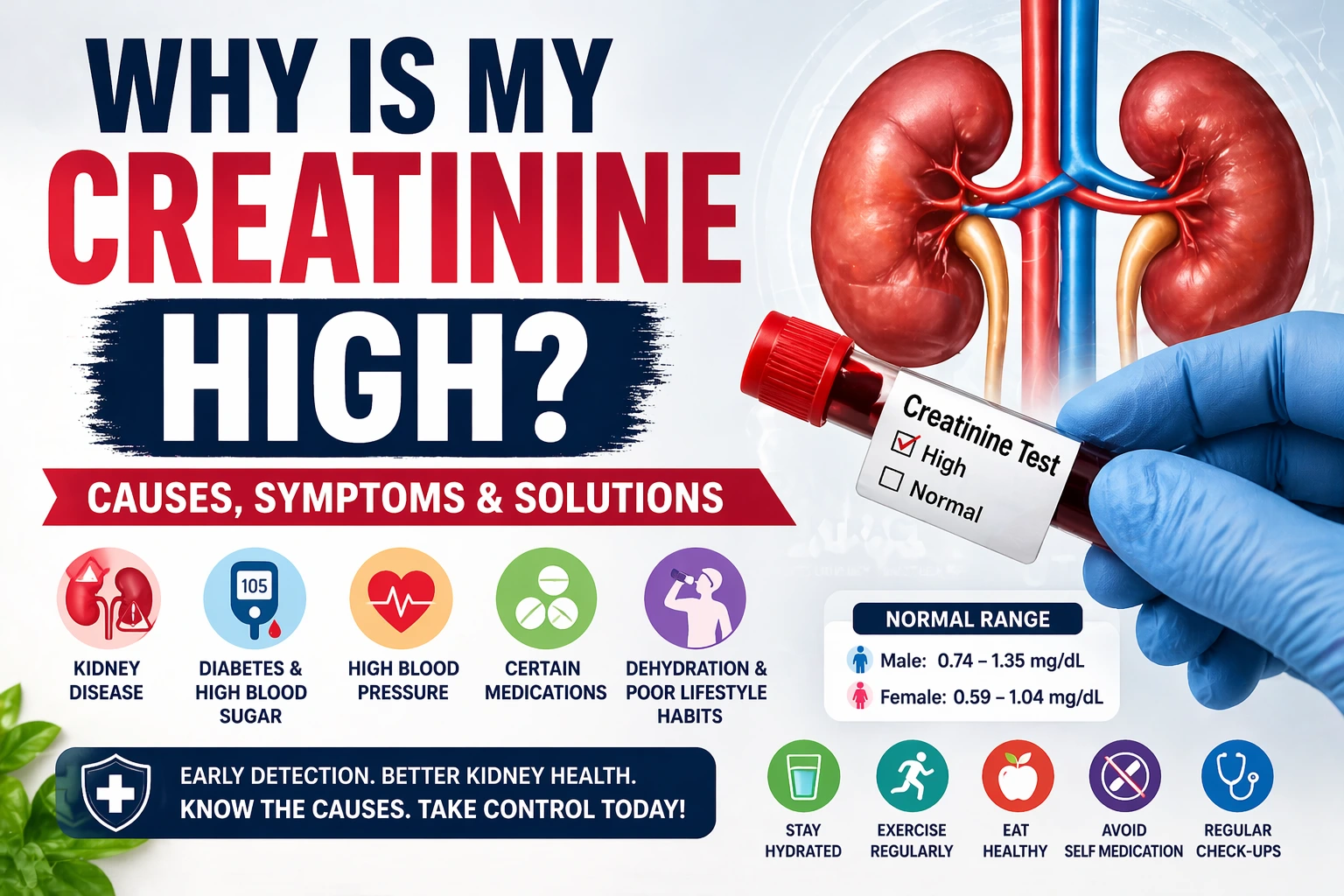
If your creatinine levels are high, it usually means your kidneys aren't getting rid of waste properly. Dehydration, kidney disease, some medications, or diseases like Chronic Kidney Disease and Type 2 Diabetes are all common causes. To take care of it, drink plenty of water, eat a kidney-friendly diet, and talk to a doctor.
So, you’ve just come back from the doctor, or maybe you’ve been scrolling through your digital health portal, and you see it: a number next to the word creatinine that looks a little bit higher than it should. Your brain immediately goes into "Condition Red" mode, and you’re wondering, “Why is my creatinine high?”
Take a deep breath. Before you start imagining yourself living on a diet of ice cubes and distilled water, let’s talk about what this actually means. High creatinine isn’t necessarily a "game over" screen; it’s more like the "Check Engine" light in your car. It’s annoying, it’s a bit scary, but it’s mostly there to tell you to take a look under the hood.
Have any renal issues? Fill in the details and get expert advice.
📞 Get a Kidney Health Consultation – Call Now!
Think of your body as a high-performance machine. Every time you move, breathe, or even just aggressively scroll through social media, your muscles are working. When muscles work, they use a fuel source called creatine. After that, fuel is burned, leaving behind a waste product called creatinine.
In short, Creatinine is basically muscle exhaustion. If the exhaust is building up in your blood, it usually means the "exhaust pipe" (your kidneys) might be moving a little slower than usual, or you’re just producing way too much "smoke" for them to handle at once.
Now, why is that number high? It’s easy to jump to the scariest conclusion, but there are actually several reasons why your creatinine might be acting up that have nothing to do with long-term kidney issues.
Dehydration: This is the most common culprit. If you haven't had enough water, your blood becomes more concentrated. Think of it like a soup that’s been simmering too long; the liquid evaporates, and the salty bits (the creatinine) get more concentrated.
The "Gym Rat" Factor: If you’re a bodybuilder or you just crushed a high-intensity workout before your blood test, your muscles have been breaking down a lot of fuel. More muscle work equals more waste. Also, if you take creatine supplements to get those "gains," your levels will naturally look higher.
Protein Overload: Did you eat a massive 16-ounce steak the night before your lab work? Red meat contains animal muscle, which, you guessed it, contains creatinine. You might literally be measuring yesterday's dinner.
Medication Side Effects: Some common drugs, like certain antibiotics or even over-the-counter painkillers (looking at you, Ibuprofen), can temporarily interfere with how your kidneys filter stuff out.
Intense Physical Stress: A high fever or a very serious illness can put your body into a breakdown state, spiking those levels.
Kidney Issues: Yes, we have to mention it. If the kidneys are damaged by things like high blood pressure or diabetes, they won't filter as well, causing the "trash" to pile up in the hallways.
📞 Get a Kidney Health Consultation – Call Now!
Here’s the tricky part: you might not feel anything at all. Creatinine itself doesn't usually cause symptoms; it’s the reason why it’s high that makes you feel weird. However, if your levels are significantly elevated, you might notice:
Changes in Urination: You’re going way more often, or way less often, or it looks like you’re peeing out a dark tea or a foamy latte.
Swelling (Edema): Your shoes feel tight, or your eyes look puffy in the morning. This is because your kidneys aren't just failing to filter waste; they’re also struggling to balance your fluids.
Fatigue: You feel like you’ve run a marathon when you’ve actually just walked to the kitchen.
Shortness of Breath: This happens when fluid starts hanging out in places it shouldn't, like your lungs.
Confusion or "Brain Fog": When waste products build up in the blood, your brain starts feeling a bit like it’s trying to think through a thick bowl of oatmeal.
Have any renal issues? Fill in the details and get an expert advice.
📞 Get a Kidney Health Consultation – Call Now!
This is where it gets a bit "science-y," but I'll keep it simple. There isn't one single "dangerous" number because everyone is different. A huge, muscular linebacker will naturally have a higher creatinine level than a petite librarian, simply because he has more muscle mass producing more waste.
Generally, doctors start to raise an eyebrow if the level goes above 1.2 or 1.3 mg/dL for most adults. However, a "dangerous" level is usually considered anything that shows a rapid, unexplained climb. If your level was 0.8 last year and it’s 2.0 today, that’s a red flag. If it hits 5.0 or higher in an acute setting, doctors might start talking about urgent interventions like dialysis to help clean the blood.
The most important thing isn't just the number, but your GFR (Glomerular Filtration Rate), which is a calculation your doctor uses to see how well your kidneys are actually functioning based on your age, sex, and creatinine.
📞 Get a Kidney Health Consultation – Call Now!
The short answer: Often, yes!
If your high creatinine is caused by dehydration, a gallon of water and a few days of rest will bring it right back down. If it’s caused by a specific medication, stopping that med (under a doctor’s guidance!) usually fixes the problem.
If the high level is due to a chronic condition like high blood pressure or diabetes, you might not "reverse" the damage that’s already done, but you can definitely stop it from getting worse. Think of it like a dent in your car door; you can’t un-dent it easily, but you can certainly stop driving into walls so you don't get any more of them.
In the United States, we use milligrams per deciliter (mg/dL) to measure this stuff. While every lab has slightly different "normal" ranges printed on their reports, here is the general ballpark for healthy adults:
|
Group |
Typical Normal Range (mg/dL) |
|---|---|
|
Adult Men |
0.7 to 1.3 |
|
Adult Women |
0.6 to 1.1 |
|
Children |
0.3 to 0.7 |
Men usually have higher levels because, biologically, they tend to have more muscle mass. If you’re a woman who lifts heavy weights and drinks protein shakes, don't be shocked if you’re on the higher end of the male range.
Have any renal issues? Fill in the details and get an expert advice.
📞 Get a Kidney Health Consultation – Call Now!
In the US, treatment isn't about "curing" the creatinine itself; it’s about fixing the source of the leak. Here is how American doctors usually tackle it:
Hydration Therapy: If you’re dehydrated, they might give you IV fluids or just tell you to drink up.
Blood Pressure Management: Since high BP is a kidney killer, you might be prescribed ACE inhibitors or ARBs, which are like a spa day for your kidney’s blood vessels.
Dietary Changes: A "renal diet" might be suggested, which involves cutting back on salt, processed foods, and sometimes excessive protein.
Managing Blood Sugar: If diabetes is the culprit, getting that A1C under control is priority number one.
Reviewing Supplements: Your doctor will likely tell you to ditch the creatine powder and the "mystery" herbal supplements for a while.
If you want to explore herbal treatment for high creatinine, visiting Karma Ayurveda USA can be a great bet. The hospital specializes in treating renal conditions, including high creatinine, with herbs and lifestyle changes.
📞 Get a Kidney Health Consultation – Call Now!
At the end of the day, your creatinine level is just one piece of the puzzle that makes up your health. It’s a very useful waste product that tells a story about your muscles, your hydration, and your kidneys.
If your creatinine level is high, talk to your doctor, drink some water, and maybe take it easy on the heavy lifting for a few days before your next blood draw. Your kidneys work incredibly hard for you, filtering hundreds of gallons of blood every day; so, give them a little love, and they’ll likely return the favor. Stay hydrated, stay informed, and remember: you are more than just a number on a lab report!
📞 Get a Kidney Health Consultation – Call Now!
A: Usually kidney issues, dehydration, too much protein, certain medicines, or heavy exercise.
A: Stay hydrated, cut down on excess protein and salt, avoid unnecessary meds/supplements, and follow your doctor’s advice.
A: Limit red meat, salty/processed foods, high-protein diets, and too much potassium or phosphorus-rich foods.
A: Yes, if dehydration is the cause, it helps flush out waste, but it’s not a cure for kidney problems.