Jun 17 , 2026
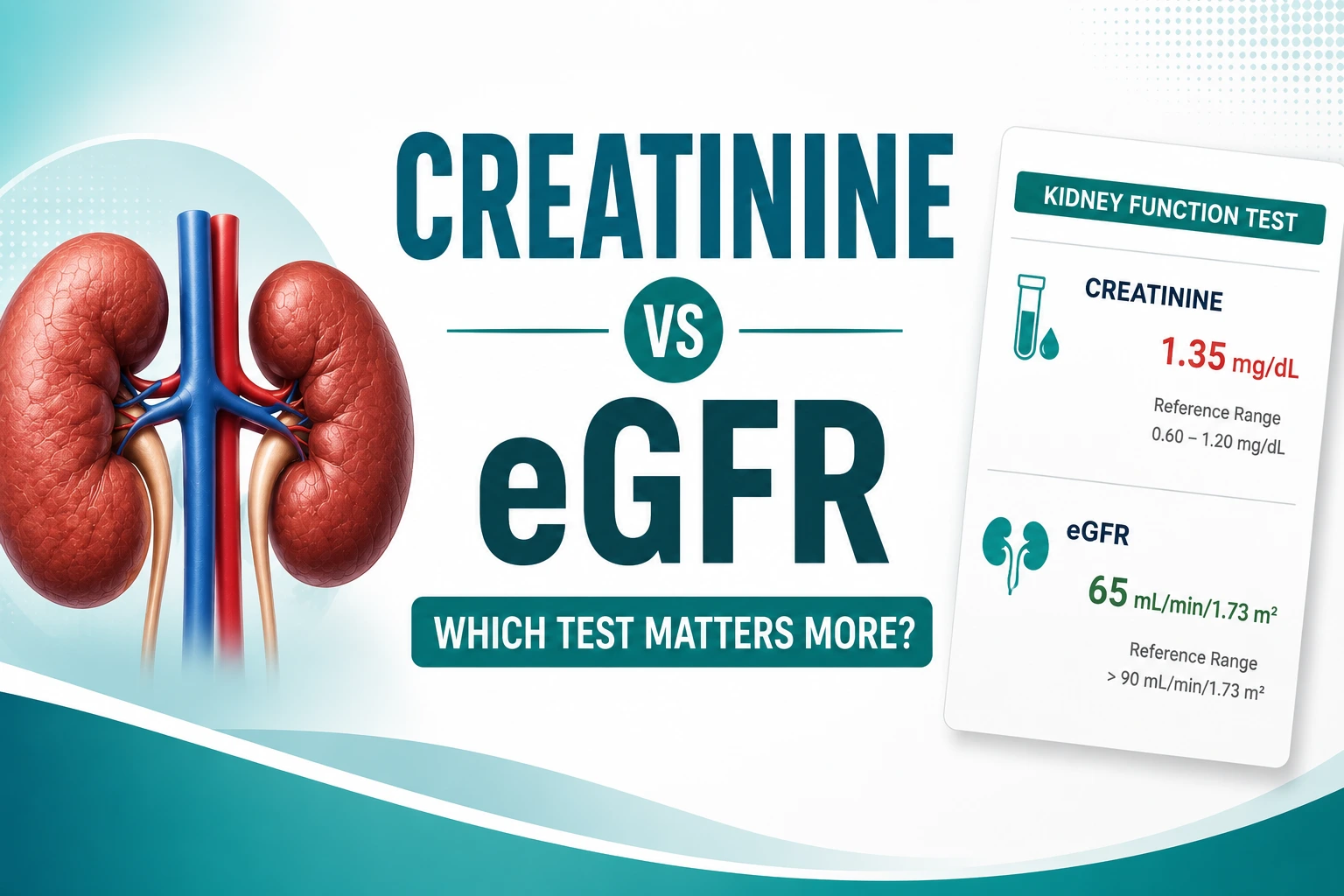
Here's the quick answer before we dive deep: both matter, but eGFR gives you the bigger, clearer picture. Think of creatinine as one piece of a puzzle, and eGFR as the puzzle already put together. Now let's get into the good stuff.
You go in for a routine check-up, your doctor scribbles something on a form, and suddenly you're staring at a lab report with numbers that look like they belong in a chemistry exam. Creatinine: 1.1 mg/dL. eGFR: 72 mL/min/1.73m². You nod as you understand, go home, and immediately Google everything.
📞 Get a Kidney Health Consultation – Call Now!
Creatinine vs eGFR is one of those medical comparisons that sounds intimidating but is actually pretty straightforward once someone explains it like a normal human being, which is exactly what we're going to do here.
Let's start simple. Creatinine is a waste product. Your muscles work hard every day (even if you personally don't feel like you're doing much), and when muscle tissue breaks down, it releases a byproduct called creatinine into your bloodstream. Your kidneys are supposed to filter it out and flush it in your urine.
If your kidneys are doing their job well, creatinine levels in your blood stay low. If they start slacking, creatinine builds up, and your blood levels rise. It's basically your body's way of ratting out your kidneys.
0.7 to 1.2 mg/dL for adult men
0.5 to 1.0 mg/dL for adult women
But here's where it gets tricky. Creatinine levels aren't equal across all people. A bodybuilder with massive muscle mass will naturally have higher creatinine than a small-framed 70-year-old woman, even if both have perfectly healthy kidneys. This is the core problem with relying on creatinine alone; it doesn't account for who you actually are.
📞 Get a Kidney Health Consultation – Call Now!
eGFR stands for estimated Glomerular Filtration Rate. Sounds fancy. It's not that scary, we promise.
Your kidneys contain tiny filtering units called glomeruli (yes, that's the plural, and yes, it's fun to say). The GFR measures how well these little guys are filtering your blood. The "e" in eGFR stands for "estimated," because this number isn't measured directly. Instead, it's calculated using your creatinine level along with your age, sex, and sometimes race. So, it takes that raw creatinine number and adds important context to it.
An eGFR of 90 or above is generally considered normal. The lower it goes, the more concerned your doctor becomes.
If you've been wondering what the difference between creatinine and eGFR is, here it is in plain English:
Creatinine is a raw measurement. eGFR is an interpretation of that measurement. Creatinine tells you how much waste is in your blood. eGFR tells you how well your kidneys are actually working, adjusted for the reality of your body.
Think of it this way. If you check the temperature outside and it says 30°C, that's like creatinine; raw data. But if your weather app tells you "feels like 38°C because of humidity," that's more like eGFR. It's taking the raw data and making it meaningful for your specific situation.
A study published in the New England Journal of Medicine by Levey et al. (2009) helped establish the CKD-EPI equation, which is one of the most widely used formulas for calculating eGFR today. Their work showed that eGFR, calculated this way, was significantly better at predicting kidney outcomes than creatinine alone.
Understanding kidney function numbers is genuinely useful for anyone managing their health long-term. Here's how eGFR translates into kidney health stages, according to the National Kidney Foundation:
|
eGFR Stage |
eGFR Value (mL/min/1.73m²) |
What It Means |
What You Should Do |
|---|---|---|---|
|
Stage 1 |
90 or above |
Normal kidney function (with other signs of damage) |
Monitor, manage risk factors |
|
Stage 2 |
60–89 |
Mildly reduced function |
Lifestyle changes, monitor closely |
|
Stage 3a |
45–59 |
Mildly to moderately reduced |
Regular nephrology check-ins |
|
Stage 3b |
30–44 |
Moderately to severely reduced |
More frequent monitoring |
|
Stage 4 |
15–29 |
Severely reduced |
Prepare for possible treatment |
|
Stage 5 |
Below 15 |
Kidney failure |
Dialysis or transplant likely needed |
The beauty of this staging system is that it's based on eGFR, not just creatinine. Because again, creatinine alone won't give you this kind of actionable clarity.
Alright, the big question: which kidney test is more accurate, creatinine or eGFR?
For most practical purposes, eGFR wins. Here's why.
A person's creatinine level can be misleading depending on muscle mass, diet, hydration status, and age. Someone who eats a lot of meat will have higher creatinine not because their kidneys are failing, but because meat is high in creatine, which converts to creatinine. Meanwhile, an elderly person with very little muscle mass might have a "normal" creatinine reading even when their kidneys are significantly impaired.
A landmark study, the MDRD Study Group (Levey et al., 1999, Annals of Internal Medicine), was one of the first major analyses to show that using a calculated estimate of filtration rate was more accurate than serum creatinine alone for identifying kidney disease. This opened the door to the widespread adoption of eGFR in clinical practice.
More recently, research published in the Journal of the American Society of Nephrology by Inker et al. (2021) introduced a race-free eGFR equation (CKD-EPI 2021), acknowledging that even the existing formula had built-in assumptions that needed updating. Science is always evolving, which is both humbling and reassuring.
That said, creatinine is still valuable. It's simple, cheap, widely available, and a necessary ingredient in calculating eGFR in the first place. You can't really have one without the other.
📞 Get a Kidney Health Consultation – Call Now!
Let's paint a few real-world scenarios where creatinine by itself could lead you astray:
Scenario one: A 25-year-old competitive weightlifter has a creatinine of 1.4 mg/dL. For most adults, that might raise a flag. But this person has exceptional muscle mass, and their kidneys are perfectly fine. Their eGFR? A healthy 88.
Scenario two: A 78-year-old woman has a creatinine of 0.8 mg/dL, well within the normal range. Looks great on paper. But because she's elderly and has lost a significant amount of muscle mass over the years, her actual kidney filtration is much lower than that number suggests. Her eGFR comes back at 52, placing her in Stage 3a chronic kidney disease.
This is precisely why doctors don't just look at creatinine. They look at eGFR. The American Journal of Kidney Diseases published a clinical practice guideline (KDOQI, 2002) that formally recommended reporting eGFR alongside creatinine for exactly this reason.
📩 Ask a Kidney Expert (Free 10-Min Consultation)
For people already diagnosed with chronic kidney disease (CKD), tracking both creatinine vs eGFR over time is important. A single number on a single day tells you relatively little. It's the trend that matters.
If your creatinine is slowly creeping up and your eGFR is slowly declining over months or years, that tells a story your doctor needs to hear. A sudden spike in creatinine could indicate an acute kidney injury; something quite different from the gradual decline of CKD.
Research from the CRIC Study Group (Feldman et al., 2003, Journal of the American Society of Nephrology) showed that monitoring eGFR trajectories over time was significantly more predictive of kidney disease progression and cardiovascular events than any single measurement
While we're here, it's worth knowing that creatinine and eGFR are not the only kidney function tests your doctor might order. A few others that often travel with them:
BUN (Blood Urea Nitrogen): Another waste product, measured alongside creatinine. A BUN-to-creatinine ratio can help tell if a problem is inside the kidneys or elsewhere.
Urine albumin-to-creatinine ratio (UACR): Measures protein leaking into the urine, an early sign of kidney stress.
Cystatin C: An alternative marker that can be used to calculate a more accurate eGFR in some cases, especially useful when muscle mass makes creatinine unreliable.
A study in JAMA (Shlipak et al., 2013) found that using cystatin C alongside creatinine to calculate eGFR was significantly better at predicting mortality and kidney outcomes, particularly in older adults. Your doctor may or may not use this, depending on your situation.
Creatinine is a useful, inexpensive, and widely available marker, but it has real limitations that can make it misleading on its own. eGFR takes creatinine and makes it smarter by factoring in who you are as a person: your age, sex, and body. For most people, eGFR is the more meaningful number for understanding how well your kidneys are actually doing their job.
That said, the best approach is to look at both, track them over time, and discuss what they mean in the context of your full health picture with your doctor.
eGFR is generally more important than creatinine because it provides a more complete picture of kidney function.
Creatinine is a waste product in the blood, while eGFR estimates how efficiently the kidneys filter blood.
A normal creatinine level does not always mean healthy kidneys, especially in older adults or people with low muscle mass.
eGFR accounts for factors like age and sex, making it more accurate for assessing kidney health.
An eGFR above 90 is considered normal, while lower values may indicate different stages of kidney disease.
Doctors use both creatinine and eGFR together to evaluate kidney function and detect chronic kidney disease (CKD).
Tracking changes in creatinine and eGFR over time is often more useful than looking at a single test result.
Additional tests such as UACR, BUN, and Cystatin C may help provide a more complete assessment of kidney health.
For CKD monitoring, declining eGFR and rising creatinine levels can signal worsening kidney function.
If you're comparing creatinine vs eGFR, eGFR is usually the better indicator of how well your kidneys are actually working.
Disclaimer: This article is for informational purposes only and does not constitute medical advice. Always consult a qualified healthcare professional for diagnosis and treatment.
📩 Ask a Kidney Expert (Free 10-Min Consultation)
A low GFR with normal creatinine can happen in early kidney disease so further evaluation may be needed.
Yes, creatinine is a blood test result, while eGFR is an estimate of how well your kidneys are filtering waste.
A normal eGFR is generally above 90, though it may naturally decline slightly with age.
Yes, eGFR is calculated using your creatinine level along with factors like age and sex.
You should consult a doctor if your creatinine is consistently above the normal range or rises suddenly.