May 14 , 2026
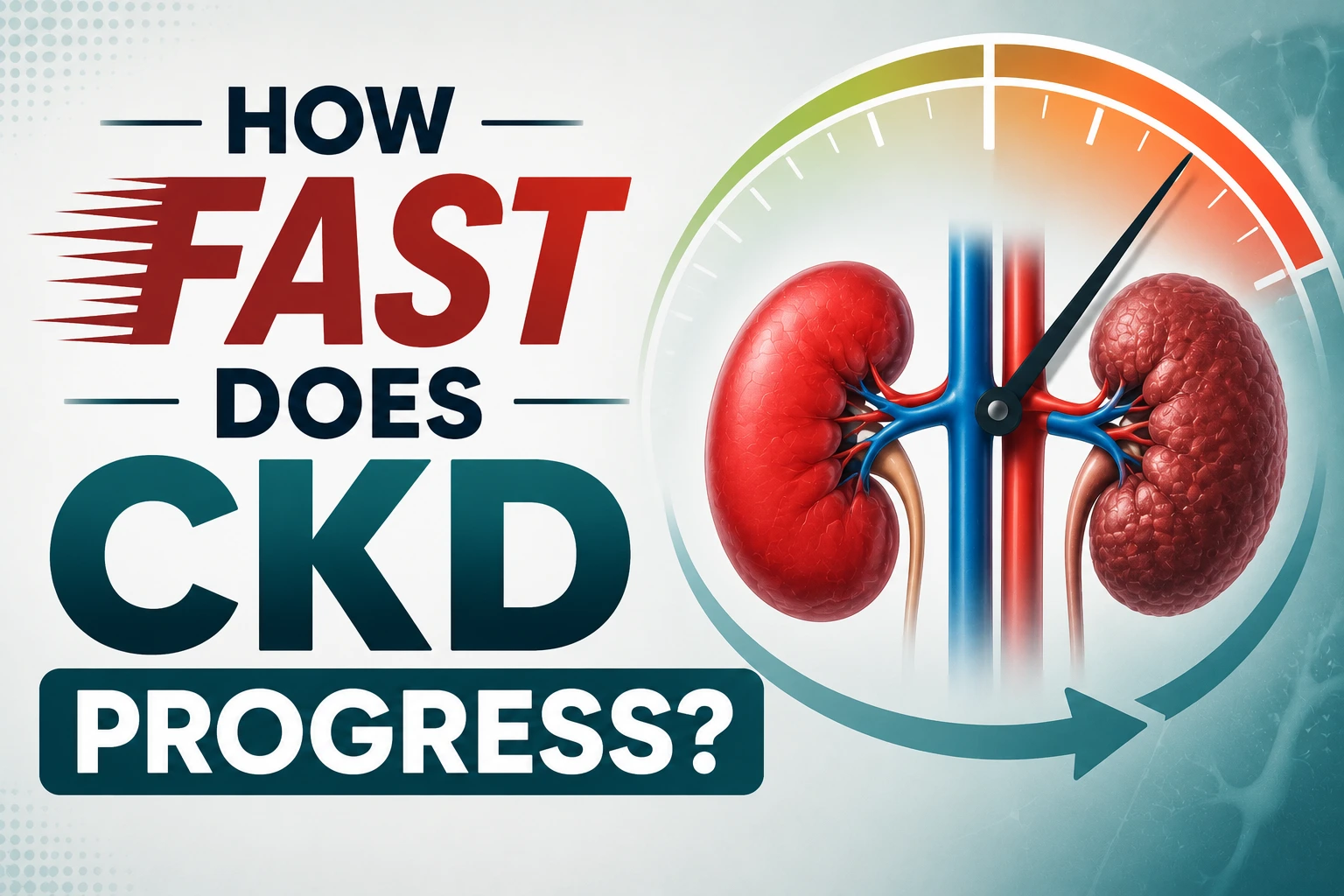
If you’ve been diagnosed with CKD, or you’re just worried because your salt intake resembles a snowy sidewalk in Chicago, take a deep breath. Having CKD doesn't mean your kidneys are going to explode tomorrow. It’s more of a slow-motion marathon than a sprint. We’re going to walk through how fast does CKD progresses, why it happens, and how to keep those bean-shaped heroes of yours in the game for as long as possible.
📞 Get a Kidney Health Consultation – Call Now!
If you are looking for a specific "miles per hour" for kidney decline, I have some good news and some frustrating news: it depends. For some people, CKD is like a dial-up internet connection in 1998; painfully slow and barely noticeable for decades. For others, it can move a bit faster.
The speed of progression is usually measured by your Glomerular Filtration Rate (GFR). Think of GFR as your kidney’s "efficiency rating." According to the United States Renal Data System (USRDS) Annual Data Report, the speed of decline is heavily influenced by how well you manage your blood pressure and blood sugar. If you ignore those two, your kidneys might decide to retire early. If you manage them, you might keep your kidneys functioning well into your golden years. Most people don’t wake up one day with total failure; it’s a gradual decline that gives you plenty of time to intervene.
Doctors love stages. It helps them categorize things, like how we categorize levels of "tired" from "need a coffee" to "I am now a sentient vegetable." CKD has five stages based on your GFR:
Stage 1: Your GFR is normal (90 or above), but there’s some evidence of kidney damage. Your kidneys are still doing a great job, but they’ve sent a "check engine" light.
Stage 2: Mild loss of function (GFR 60-89). You still feel fine, and your kidneys are still winning the "Employee of the Month" award.
Stage 3: This is the middle ground (GFR 30-59). This is usually when people start noticing they’re a bit more tired or have some swelling.
Stage 4: Severe loss of function (GFR 15-29). This is the "we need a serious game plan" phase.
Stage 5: Kidney failure (GFR less than 15). This is where dialysis or a transplant enters the conversation.
📞 Get a Kidney Health Consultation – Call Now!
What actually makes it progress? Imagine your kidneys are a high-end coffee filter. If you pour clean water through it, it lasts forever. If you start pouring sludge, syrup, and tiny pebbles through it, it’s going to clog up. In the human body, that "sludge" is usually high blood pressure and high blood sugar.
When your blood pressure is high, it pounds against the delicate vessels in your kidneys like a sledgehammer. Over time, this creates scarring. The Chronic Renal Insufficiency Cohort (CRIC) Study found that patients with uncontrolled hypertension saw a significantly faster drop in their GFR compared to those who kept their blood pressure in the "boring and healthy" range. Essentially, your kidneys are sensitive; they don’t like being bullied by your blood flow.
Since kidneys don’t have nerves that scream "Ouch!" when they’re struggling, you have to look for the subtle hints they drop. They are the passive-aggressive roommates of the organ world. Signs that things might be heading south include:
Puffy Eyes and Ankles: You look like you’ve been crying or wearing socks that are three sizes too small. This is fluid retention.
The "Metal" Taste: Some people report that food starts tasting like they’re licking a copper pipe.
Fatigue: Feeling like you’ve run a marathon when you only walked to the mailbox.
Foamy Urine: If your trip to the bathroom looks like a freshly poured root beer, that’s often a sign of protein leaking out.
If you are experiencing these symptoms, better rush to a renowned medical facility like Karma Ayurveda USA. A stitch in time saves nine, as they say.
📞 Get a Kidney Health Consultation – Call Now!
If you have CKD, you are in very crowded company. Roughly 37 million American adults are estimated to have CKD. That is about 15% of the adult population. To put that in perspective, that’s more people than the entire population of Texas.
The National Health and Nutrition Examination Survey (NHANES) consistently shows that a huge chunk of these people don’t even know they have it. In the US, our diet of "everything-is-supersized-and-covered-in-salt" doesn’t help. Because CKD is so common here, the American healthcare system has become very good at screening for it, provided you actually go to your annual check-up and let them poke you with a needle.
Treatment in the US is less about "fixing" the kidney (since they don't really heal like a scraped knee) and more about "preserving" what you’ve got. Doctors usually go for the "Triple Threat" approach:
ACE Inhibitors or ARBs: These are blood pressure meds that act like a protective shield for kidney filters.
SGLT2 Inhibitors: Originally for diabetes, these have become the "wonder drugs" of the kidney world. The DAPA-CKD Trial showed these meds significantly reduced the risk of kidney failure and death in patients with CKD.
Dietary Overhaul: This means breaking up with the salt shaker and perhaps seeing a renal dietitian who will tell you that, no, a double bacon cheeseburger is not a "balanced meal."
📞 Get a Kidney Health Consultation – Call Now!
If you are Stage 2 or 3, you might stay there for 10, 20, or 30 years. It isn’t a countdown clock that hits zero on a specific date. A study titled AJKD: Lifetime Risk of End-Stage Renal Disease suggests that many people with early-stage CKD will actually die of old age (or a rogue piano falling from a window) long before their kidneys actually fail.
The timeline is largely in your hands. If you smoke, eat salt like it’s a food group, and ignore your doctor, the timeline speeds up. If you behave, you can stretch that timeline out long enough to see your great-grandchildren graduate from college.
Absolutely. This is the most important part! You aren't a passenger on a sinking ship; you’re the captain with a really good bucket.
Control the Sugar: If you have diabetes, keep that A1C in check.
Watch the Salt: Salt pulls water into your blood, raising pressure. Try herbs. They make you look fancy and taste better anyway.
Move Your Body: You don't have to be an Olympic athlete. A brisk walk while listening to a podcast about 18th-century hat-making is plenty.
Hydrate (But Don’t Overdo It): Water is good, but you don't need to drown yourself. Listen to your thirst.
The Modification of Diet in Renal Disease (MDRD) Study proved that blood pressure control and protein management could significantly put the brakes on the progression of the disease. It’s science-backed laziness prevention!
Having CKD isn't a death sentence for your social life or your kidneys. It’s just a sign that you need to be a little more intentional about how you treat your body. Think of your kidneys as two very hardworking, slightly grumpy filters that just need a little respect and a lot less sodium.
Stay on top of your labs, talk to your doctor, and maybe trade that second bag of chips for an apple. Your kidneys will thank you by continuing to do their job quietly in the background, just the way they like it.
📞 Get a Kidney Health Consultation – Call Now!
It varies a lot; kidney disease can worsen slowly over years or faster within months, depending on the cause and treatment.
For some people it takes several years, while others may progress faster if diabetes, high blood pressure, or other risks aren’t controlled.
Many people live for decades with chronic kidney disease, especially when it’s managed early and properly.
Yes, kidney damage can happen within 3 months, especially in cases of infection, dehydration, diabetes, or certain medicines.