Jun 19 , 2026
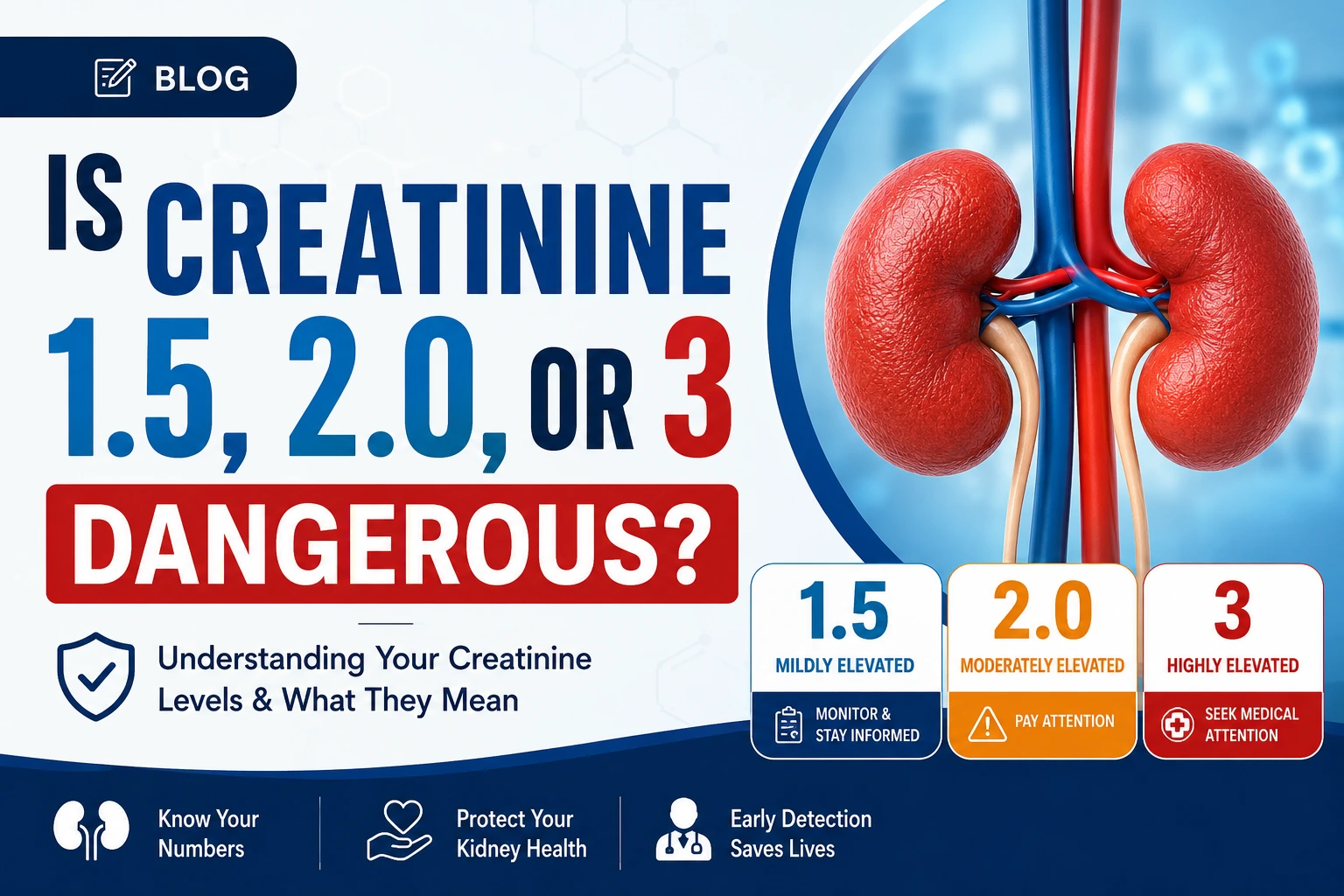
Let's just get straight to it: dangerous creatinine levels are generally considered anything above 2.0 mg/dL in adults, though the full picture is a lot more nuanced than that one number. Your kidneys are either doing their job, or they're quietly staging a protest, and creatinine is basically the whistle-blower.
Now before you spiral into a 2 a.m. Google rabbit hole (we've all been there), let's break this down in plain English; no medical jargon, no unnecessary panic, just the facts your doctor probably forgot to explain between the 4-minute appointment and handing you a lab printout.
📞 Get a Kidney Health Consultation – Call Now!
Creatinine is a waste product. That's it. Your muscles produce it constantly as a byproduct of normal activity, and your kidneys are supposed to filter it out through urine. Think of it like the exhaust from a car engine; totally normal to produce, but a problem if it starts building up in the cabin.
When your kidneys are healthy, they're like efficient little filters, clearing creatinine out at a steady rate. When they're struggling, creatinine starts piling up in your blood, and that's when the numbers on your lab report start looking scary.
According to Levey et al., Annals of Internal Medicine (2003), elevated serum creatinine is one of the earliest detectable signs of declining kidney function and is strongly correlated with reduced glomerular filtration rate (GFR). In other words, it's one of the first red flags your body waves.
Here's something most people don't realize: the normal creatinine range isn't one-size-fits-all. It varies based on age, sex, muscle mass, and even your diet. But as a general guide:
Adult men: 0.7 to 1.3 mg/dL
Adult women: 0.6 to 1.1 mg/dL
Children: 0.2 to 1.0 mg/dL (varies by age)
Elderly adults: Slightly lower, since muscle mass decreases with age
If you're a bodybuilder eating chicken every two hours, your baseline might run a little higher than someone with a more sedentary lifestyle, and that's perfectly fine. Context always matters.
📞 Get a Kidney Health Consultation – Call Now!
This is one of the most searched questions out there, and honestly, creatinine 1.5 sits in an uncomfortable middle ground. It's above normal for most women and on the higher end for men; not yet in the "call your doctor right now" zone, but definitely a "let's keep an eye on this" territory.
A single reading of 1.5 mg/dL shouldn't send you into full panic mode. Dehydration alone can temporarily push creatinine up. So can a protein-heavy meal the day before your blood test, intense exercise, or certain medications like NSAIDs or ACE inhibitors.
Ix et al., Kidney International (2011) found that even mildly elevated creatinine in otherwise healthy adults can predict long-term cardiovascular and kidney risk, which is why doctors track trends over time rather than reacting to a single number. If you hit 1.5 once, drink some water and retest. If you hit 1.5 consistently across multiple readings, that's the conversation worth having.
📩 Ask a Kidney Expert (Free 10-Min Consultation)
Is creatinine 2.0 dangerous? Okay, now we're getting into territory that warrants a more serious conversation with your doctor. A reading of 2.0 mg/dL typically signals that your kidneys are working at roughly 50% of their normal capacity, which isn't an emergency, but it's definitely not something to shrug off either.
At this level, most nephrologists would classify you in the chronic kidney disease (CKD) stage 3 range, depending on your GFR. Symptoms might still be mild or even absent at this point, which is exactly what makes kidney disease so sneaky.
Go and Chertow, New England Journal of Medicine (2004) demonstrated that a creatinine level around 2.0 mg/dL is associated with significantly increased risk of end-stage renal disease and cardiovascular events, making early intervention critical.
So no, 2.0 isn't "drop everything and go to the ER" territory; but it is "make an appointment this week, not next month" territory.
Here's the cruel joke about high creatinine: your body doesn't exactly send you a notification. Most people with mildly elevated levels feel completely fine. But as levels rise, high creatinine symptoms can start to show up in annoying, easy-to-ignore ways:
Fatigue and general sluggishness (the kind where coffee doesn't help)
Swelling in the feet, ankles, or around the eyes
Decreased urine output or changes in urine color
Nausea and vomiting (especially in the mornings)
Shortness of breath without much exertion
Confusion or difficulty concentrating
Itchy skin; particularly on the back, arms, and legs
A persistent metallic taste in your mouth (yes, really)
Kalantar-Zadeh et al., Journal of the American Medical Association (2017) found that many patients with moderately elevated creatinine levels don't report symptoms until kidney function drops below 30% of normal; underscoring why routine blood work is so important even when you feel fine.
📞 Get a Kidney Health Consultation – Call Now!
|
Creatinine Level (mg/dL) |
What It Likely Means |
Action to Take |
|---|---|---|
|
0.6 – 1.1 (women) / 0.7 – 1.3 (men) |
Normal range; kidneys are happy |
Routine monitoring |
|
1.2 – 1.5 |
Mildly elevated; worth watching |
Retest, stay hydrated, review medications |
|
1.5 – 2.0 |
Moderately elevated; early kidney stress |
Schedule a doctor appointment soon |
|
2.0 – 3.0 |
Significantly elevated; kidney function reduced |
See a nephrologist, discuss CKD staging |
|
Above 3.0 |
Severely elevated; serious kidney impairment |
Urgent medical attention required |
|
Above 5.0 |
Potential kidney failure |
Emergency evaluation needed |
If someone asks what does a creatinine level of 3.0 mean, the honest answer is: your kidneys are in significant trouble and need immediate medical attention.
At 3.0 mg/dL, kidney function is typically reduced to somewhere between 25–35% of normal. This usually places someone firmly in CKD Stage 4, one step away from kidney failure. At this point, doctors often begin preparing patients for the possibility of dialysis or even transplant; not to scare anyone, but because early preparation matters enormously.
Symptoms at this stage become much harder to ignore: severe fatigue, major fluid retention, dramatically reduced urination, and sometimes confusion or neurological symptoms as toxins accumulate in the blood.
Coresh et al., JAMA (2007) published landmark data showing that creatinine levels at or above 3.0 mg/dL corresponded with dramatically increased mortality risk and rapid progression to end-stage renal disease without aggressive intervention.
📞 Get a Kidney Health Consultation – Call Now!
So, what tips creatinine into the dangerous creatinine levels zone in the first place? There's a surprisingly long list:
Chronic kidney disease; the most common cause
Diabetes; high blood sugar damages kidney filters over time
High blood pressure; consistently elevated BP wears down kidney vessels
Dehydration; even temporarily concentrates creatinine in blood
Certain medications; NSAIDs, aminoglycosides, some antibiotics
Rhabdomyolysis; rapid muscle breakdown from injury, extreme exercise, or certain drugs
Urinary tract obstructions; kidney stones or prostate issues
Autoimmune conditions; lupus nephritis being a common culprit
Ritz and Orth, New England Journal of Medicine (1999) established that diabetic nephropathy is the leading cause of chronically elevated creatinine in developed countries, responsible for roughly 40% of all end-stage renal disease cases.
Good news: in many cases, yes, especially if the cause is reversible. Here's what actually helps:
Stay well hydrated; water is free, and your kidneys love it
Reduce protein intake temporarily; especially red meat and protein supplements
Limit intense exercise during flare-ups, as muscle breakdown raises creatinine
Cut back on NSAIDs like ibuprofen and naproxen
Control blood pressure; seriously, it's one of the biggest levers you have
Manage blood sugar if you're diabetic
Cooked fiber-rich foods like cabbage and cauliflower have been studied for their kidney-supportive effects
Kalantar-Zadeh et al., BMJ (2017) found that dietary interventions including reduced protein and sodium intake significantly slowed the progression of CKD in patients with elevated creatinine levels.
That said, if your creatinine is truly elevated due to structural kidney damage, lifestyle changes help slow progression but aren't a magic eraser. That's why working with a nephrologist is so valuable.
Stop Googling and actually call your doctor if:
Your creatinine is above 2.0 mg/dL on multiple readings
You notice swelling, reduced urination, or extreme fatigue alongside elevated numbers
You have diabetes or high blood pressure and haven't had your kidneys checked recently
Your creatinine is rising over time even within the "normal" range
You're experiencing the metallic taste, itchy skin, or confusion mentioned earlier
And if your creatinine is at or above 3.0, honestly, yesterday would have been a good time to call.
Dangerous creatinine levels don't happen overnight; they're usually the result of months or years of kidney stress that went unnoticed or unaddressed. The good news is that creatinine is one of the easiest things to track with a simple, affordable blood test.
Know your numbers. Get your bloodwork done at least once a year. And if your doctor mentions creatinine at your next appointment, don't tune out and nod along; ask questions. Your kidneys have been quietly working overtime for you, and they deserve at least a little attention back.
This article is for informational purposes only and does not constitute medical advice. Always consult a qualified healthcare provider for diagnosis and treatment.
Creatinine is a waste product filtered by your kidneys, and elevated levels can indicate declining kidney function.
Normal creatinine levels are typically 0.7–1.3 mg/dL for men and 0.6–1.1 mg/dL for women, though age, muscle mass, and diet can influence results.
A creatinine level of 1.5 mg/dL is mildly elevated and may result from dehydration, intense exercise, medications, or early kidney stress.
A creatinine level of 2.0 mg/dL often suggests reduced kidney function and may indicate Stage 3 Chronic Kidney Disease (CKD), requiring medical evaluation.
A creatinine level of 3.0 mg/dL or higher is considered serious and is commonly associated with advanced kidney disease (Stage 4 CKD).
Common symptoms of high creatinine include fatigue, swelling, decreased urination, nausea, shortness of breath, itchy skin, and difficulty concentrating.
Major causes of dangerous creatinine levels include CKD, diabetes, high blood pressure, dehydration, kidney stones, certain medications, and autoimmune diseases.
Lifestyle measures such as proper hydration, blood pressure control, blood sugar management, and a kidney-friendly diet may help slow kidney damage and support kidney health.
Seek immediate medical attention if creatinine levels continue rising, exceed 3.0 mg/dL, or are accompanied by significant symptoms.
Regular blood tests and early intervention are key to preventing progression toward kidney failure and dialysis.
A creatinine level of 3.0 is considered high and may indicate significant kidney function impairment.
Not necessarily; dialysis depends on overall kidney function and symptoms, not creatinine alone.
Creatinine levels above the normal range, especially over 4–5 mg/dL, often require urgent medical evaluation.
Creatinine levels above 5 mg/dL are generally considered dangerously high and may signal severe kidney damage.