Aug 13 , 2026
So, here's the answer up front, no drumroll needed: CKD stage 5 treatment basically comes down to three roads; dialysis, a kidney transplant, or conservative (non-dialysis) care; and which one is "right" depends on your body, your age, and honestly, what kind of life you actually want to live. That's the whole answer in one breath. Now let's unpack it, because kidney stuff is confusing enough without a doctor talking to you in acronyms while you're sitting there in a paper gown wondering if you should've Googled this at home instead.
📞 Get a Kidney Health Consultation – Call Now!
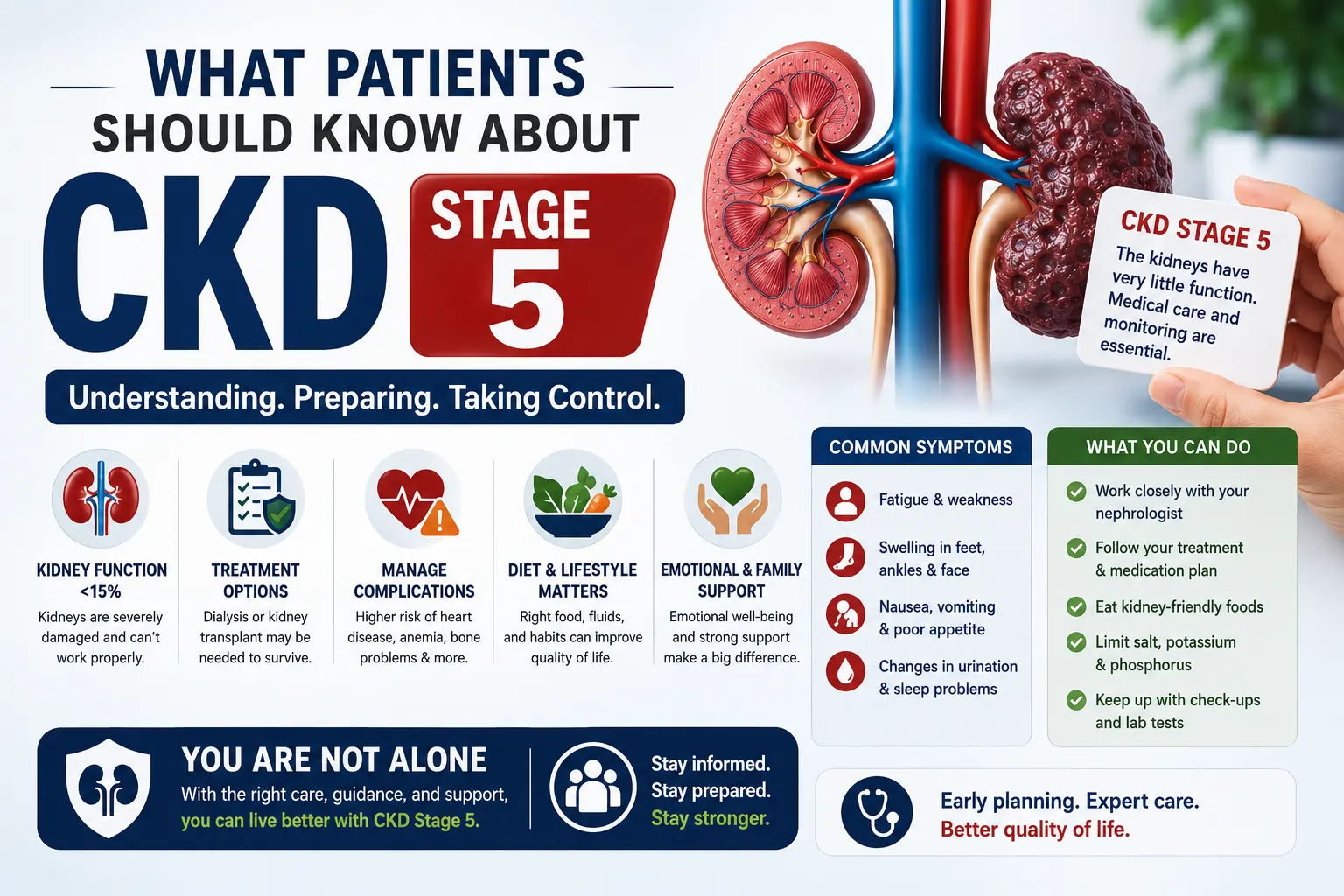
Think of your kidneys like a pair of very committed, very underappreciated janitors. They filter your blood, kick out waste, and balance your fluids 24/7, no lunch breaks. CKD stage 5 (also called end-stage kidney disease or kidney failure) is when those janitors are basically down to about 15% capacity or less; technically an eGFR under 15. At this point, your kidneys are still trying, bless them, but they can't keep up on their own anymore.
This is also the stage where you'll actually feel it. Common CKD stage 5 symptoms include swelling in the legs and face, constant fatigue, nausea, itchy skin, trouble concentrating (kidney brain fog is real), and a metallic taste that makes even your favorite snacks taste like a science experiment gone wrong.
Here's where CKD stage 5 treatment decisions get personal. None of these are "one size fits all," and a good kidney disease doctor will walk you through the tradeoffs instead of just handing you a pamphlet.
Hemodialysis – blood is filtered outside the body via a machine, usually 3x a week at a center (or at home, if you're feeling ambitious).
Peritoneal dialysis – filtering happens inside your belly using your own lining as a filter, done daily at home.
Kidney transplant – a new kidney, either from a living donor or deceased donor list, offering the closest thing to "normal" kidney function again.
Conservative management – symptom-focused care without dialysis, often chosen by older patients or those with heavy comorbidities.
A 2007 study published in Nephrology Dialysis Transplantation by Murtagh and colleagues found that in patients over 75 with advanced renal failure, dialysis improved survival; but that advantage shrank significantly in patients with heart disease or heavy comorbidity, meaning conservative care wasn't automatically the "lesser" option for everyone. Similarly, a 2017 study in PLOS ONE by Reindl-Schwaighofer et al. found that elderly patients on hemodialysis had notably lower mortality risk compared to those managed conservatively; so honestly, the "right" answer really does depend on the individual, not a blanket rule.
📞 Get a Kidney Health Consultation – Call Now!
|
Category |
Dialysis |
Transplant |
|
Time commitment |
Basically a part-time job, unpaid |
Surgery once, then check-ups |
|
Diet |
Says goodbye to bananas and cheese, forever |
Much more relaxed |
|
Waiting list |
None, starts right away |
Can take years |
|
Vibe |
"I have an appointment with a machine" |
"I have a new roommate, organ edition" |
A newer 2025 study in JAMA Internal Medicine looked at over 7,500 adults with stage 5 CKD in Canada and found something unexpected: women under 55 with kidney failure actually had worse survival outcomes than men of the same age, and were also less likely to receive transplants; flipping the usual "women live longer" pattern seen in the general population. It's a reminder that end-stage kidney disease treatment isn't just about the kidneys; age, sex, and access to care all quietly shape the outcome too.
CKD stage 5 treatment includes dialysis, transplant, or conservative care; there's no universal "best" option.
Symptoms like swelling, fatigue, and brain fog are common signals your kidneys need backup.
A kidney transplant generally offers better long-term survival, but comes with a waiting list.
Research shows outcomes vary by age, sex, and existing health conditions; this isn't one-size-fits-all.
Talk to your care team early; decisions made in a calm moment tend to age better than panic decisions.
📩 Ask a Kidney Expert (Free 10-Min Consultation)
Getting to stage 5 sounds terrifying on paper, and yes, it's a big deal; but it's also one of the most studied and well-managed areas in modern medicine. You are not the first person to sit with this news, and you won't be the last to come out the other side living an actual, full life.
There isn't one universal best option; it depends on your age, health, and lifestyle, so this is a conversation to have with your doctor, not a Google search.
No, stage 5 kidney damage is generally permanent, but treatment can manage symptoms and extend quality of life significantly.
Life expectancy varies widely depending on treatment choice, age, and other health conditions, so it's more of a range than a fixed number.
Dialysis itself typically isn't painful, though some people feel tired or crampy afterward, especially early on.
As soon as you notice symptoms like swelling, fatigue, or changes in urination; earlier visits generally lead to better long-term outcomes.
Disclaimer: This blog is for general informational purposes only and is not a substitute for professional medical advice, diagnosis, or treatment. Kidney disease management is highly individual; always consult a qualified nephrologist or healthcare provider before making decisions about your care.
