

Jul 14 , 2026
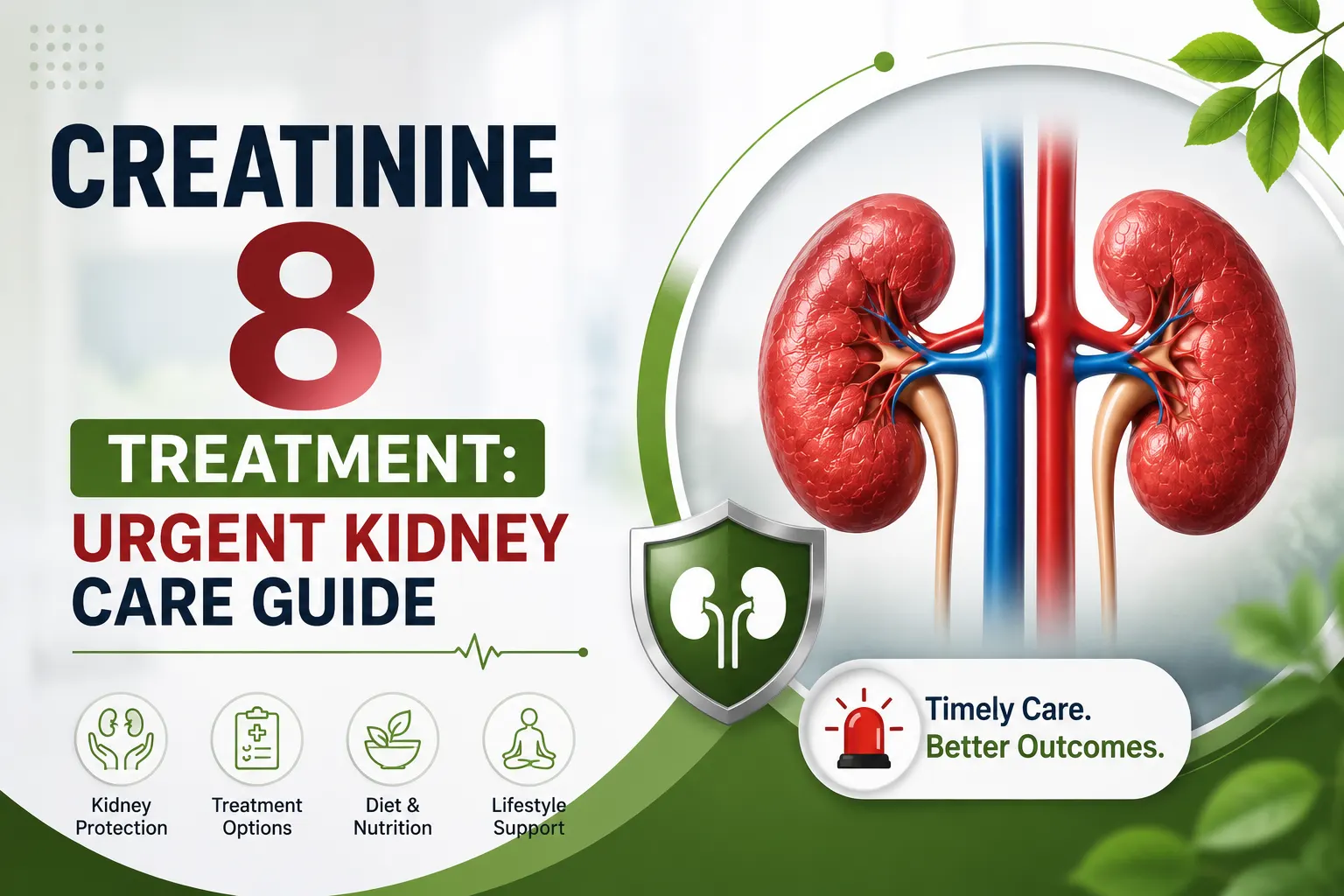
If your report just came back showing creatinine at 8, here's the short answer: this is a medical emergency, and creatinine 8 treatment almost always means dialysis, right away, under a nephrologist's care; not home remedies or "let's wait and watch." Now let's talk about why, and what actually happens next.
Look, nobody Googles "creatinine 8" on a good day. You're probably sitting with a lab report in one hand and your phone in the other, heart doing that anxious little flutter. So let's skip the jargon-fest and talk like two people at a chai stall, except one of us apparently read too many nephrology journals.
Creatinine is basically muscle "exhaust fumes." Your muscles produce it constantly, and your kidneys are the exhaust pipe; they filter it out and send it packing via urine. A normal creatinine level for most adults sits somewhere between 0.6 and 1.2 mg/dL, depending on age, muscle mass, and honestly, how much protein you had for dinner.
When creatinine hits 8, your kidneys aren't just "having a rough week." They're functioning at a fraction of their capacity; we're talking possibly less than 10-15% of normal filtering power. That's not a "drink more water and see" situation. That's a "get to a hospital today" situation.
Pretty much, yes. A creatinine of 8 typically signals either advanced kidney failure or acute renal failure, depending on how fast it climbed:
If it shot up over days (say, after an infection, dehydration, a drug reaction, or surgery), it's likely Acute Kidney Injury (AKI); and the encouraging part is AKI can sometimes be partially or fully reversible if caught and treated fast.
If it climbed slowly over months or years (often from long-standing diabetes or high blood pressure), it's likely Chronic Kidney Disease (CKD) reaching End-Stage Renal Disease (ESRD), and this usually needs long-term dialysis or a transplant.
A widely cited cohort study published in BMC Nephrology (Perez-Valdivieso et al.) followed over a thousand patients with acute renal failure and found that how sharply creatinine rose before treatment began was directly linked to survival odds and recovery of kidney function; basically, speed of diagnosis and treatment matters enormously. Translation: don't sit on this report.
Here's the honest, no-sugarcoating checklist for what to do when creatinine is 8:
Go to a nephrologist or ER immediately; not a general physician "next week," today.
Expect dialysis discussions; hemodialysis or peritoneal dialysis is often started to remove toxins your kidneys can no longer clear.
Get a full workup; blood tests, ultrasound, sometimes a kidney biopsy to find the "why" behind the number.
Review your medications; some painkillers, contrast dyes, and even certain herbal supplements can quietly wreck kidney function.
Manage the underlying cause; diabetes, blood pressure, infections, or blockages need parallel treatment, not just the creatinine number.
A large registry-based study of over 20,000 dialysis patients (published via the Scientific Registry of Transplant Recipients data, led by researchers including Amanda Vinson) found that even people with pre-transplant creatinine in the 5-8+ range could still have reasonably good outcomes post-transplant; meaning a high number today doesn't automatically write your story's ending.
Because everyone throws these terms around like confetti at a wedding, here's a cheeky little breakdown:
|
Term |
What It Actually Means |
Vibe Check |
|
Kidney Failure |
Kidneys have mostly stopped filtering waste |
"The exhaust pipe is basically welded shut" |
|
Renal Failure |
Same thing, fancier medical Latin |
"Renal" just means "kidney" wearing a lab coat |
|
AKI (Acute) |
Sudden, often reversible drop in function |
"Kidneys had a bad week, not a bad life" |
|
CKD/ESRD (Chronic) |
Long-term, progressive, usually permanent decline |
"This has been brewing for years, quietly" |
A proper kidney treatment plan at this stage usually blends a few pillars together, and honestly, none of them work well in isolation:
Dialysis to physically remove toxins and excess fluid
Diet changes; lower potassium, phosphorus, and sodium, because your kidneys can't handle the extra load right now
Medication management for blood pressure, anemia, and bone health
Fluid monitoring so you're not retaining water like a sponge in a bathtub
Regular follow-ups with your care team to track whether numbers are improving or a transplant conversation needs to start
A study evaluating hemodialysis patients (published in Medicine journal) found significantly higher creatinine along with clear shifts in other blood markers like albumin and hemoglobin compared to healthy controls; reinforcing that creatinine rarely travels alone. It usually shows up with a whole entourage of imbalances that also need attention.
This is not the moment to Google "best home remedy for kidneys" at 2 AM. You need an actual kidney disease doctor; a nephrologist; who can read your full picture (not just one number) and build a plan around it. Ask about their experience with dialysis initiation, transplant referrals, and honestly, don't be shy about getting a second opinion if something feels rushed or unclear.
Here's the thing nobody says enough: getting real kidney support matters just as much as the medical treatment. That means leaning on family, joining patient support groups (many hospitals run these), and being honest with your doctor about how you're coping; physically and emotionally. Dialysis schedules are demanding, diet changes are annoying, and some days you'll just want to eat a samosa without doing potassium math in your head. That's normal. Talk about it.
A creatinine level of 8 is a medical emergency requiring immediate nephrology care, not a wait-and-watch number.
It usually points to either acute kidney injury (potentially reversible) or advanced chronic kidney disease (usually long-term).
Treatment typically involves dialysis, dietary changes, medication management, and treating the root cause.
Outcomes vary a lot by individual; high creatinine today doesn't automatically mean a fixed, permanent outcome.
A good nephrologist and a solid support system are just as important as the treatment itself.
No; with prompt treatment like dialysis, many people stabilize and even improve, especially if the cause is acute rather than chronic.
Rarely, and only in select acute cases caught early; most people at this level need dialysis support while the underlying cause is treated.
It depends entirely on the cause, overall health, and how quickly treatment starts; some people live for years on dialysis or after a transplant.
No; diet helps manage the load on the kidneys, but at this stage it supports treatment, it doesn't replace dialysis or medical care.
Yes, absolutely; a second nephrologist's opinion is completely normal and often reassuring when facing decisions this big.
Disclaimer: This blog is for general informational purposes only and is not a substitute for professional medical advice, diagnosis, or treatment. Creatinine levels and kidney health vary hugely by individual. Please consult a qualified nephrologist or doctor directly for any decisions regarding your health.

Karma Ayurveda, established in 1937, is an Ayurvedic hospital with a rich legacy of over eight decades. Led by Dr Puneet Dhawan, the fifth generation... Read More About Us
100 Church Street, Suite 800, New York, NY 10007

US FDA Reg. No.: 14568299376

How may we help you?