Jun 08 , 2026
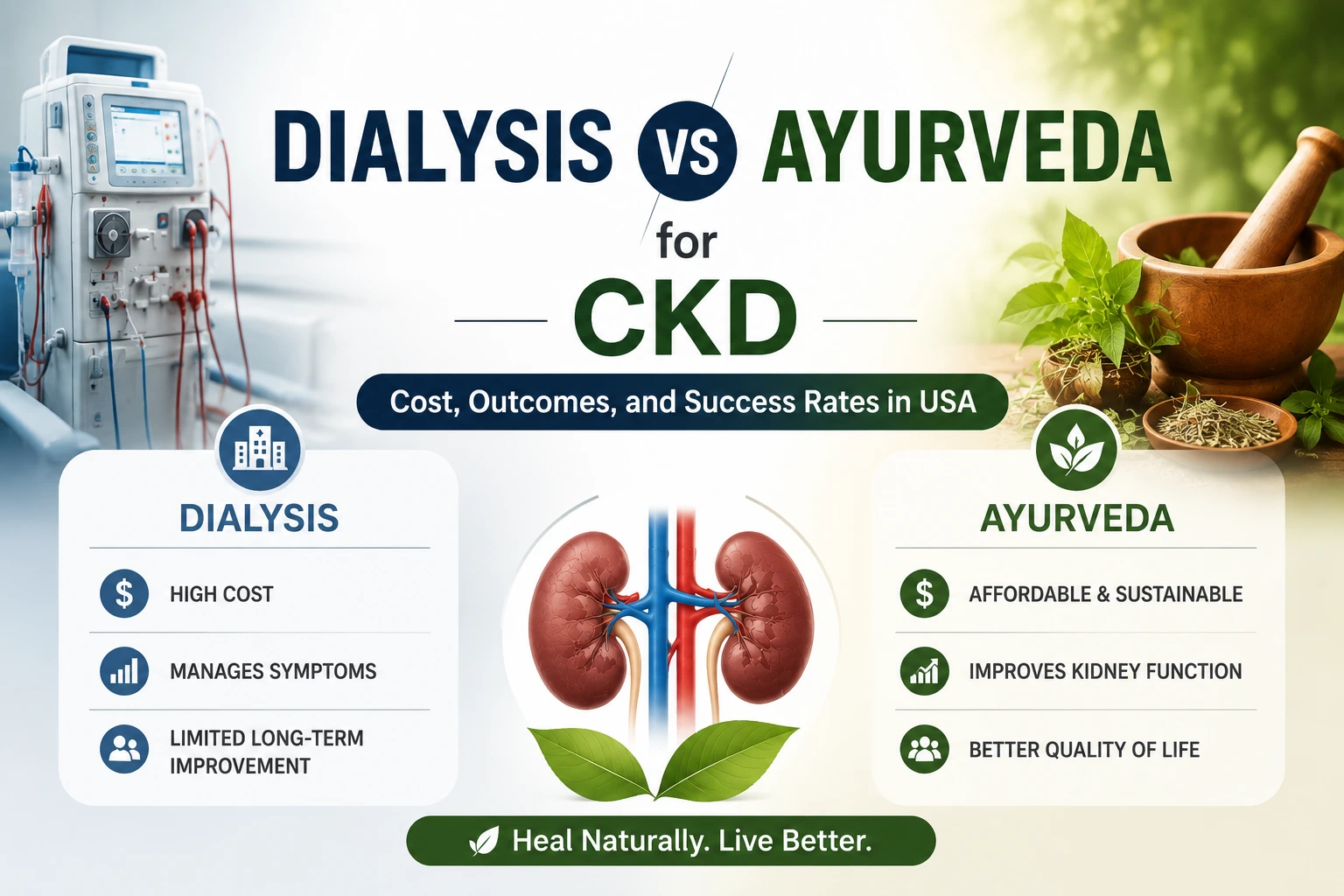
Choosing between dialysis and Ayurveda can feel a bit like choosing between a high-tech spaceship and a magical flying carpet. Both promise to take you somewhere better, but the journey, the fuel, and the toll on your wallet are vastly different. Today, we are breaking down dialysis vs Ayurveda for CKD with a magnifying glass, focusing on the cold hard cash, the clinical outcomes, and the success rates right here in the United States. No emojis, no fluff; just pure, humorous, and science-backed truth.
📞 Get a Kidney Health Consultation – Call Now!
Before we talk about money and metrics, let’s introduce our two rivals.
In the left corner, wearing the sterile white lab coat, is dialysis. Dialysis is basically an external, mechanical kidney. When your biological filters decide to go on an indefinite strike (usually around Stage 5 CKD), this machine steps in to pump your blood out, wash away the toxins, and send it back in. It is a literal lifesaver, but it treats the machine, not the underlying cause.
In the right corner, smelling faintly of turmeric and warm sesame oil, is Ayurveda. This system views CKD not just as a localized "kidney glitch," but as a systemic traffic jam of your biological energies (specifically the Vata and Kapha doshas) and an accumulation of metabolic waste called Ama. Instead of replacing your kidneys, it uses heavy-duty herbal formulations, strict dietary overhauls, and therapies like Basti (medicated enemas) to revive whatever function your kidneys have left.
So, which one takes the crown for the best kidney treatment USA patients can access? Let’s look at what happens when these two philosophies collide.
When Americans look for a chronic kidney disease treatment USA option, they want numbers. They want to know: Will this keep me alive, and will I still enjoy my Sunday football?
Dialysis is highly effective at keeping you from succumbing to uremic poisoning. If your kidneys are entirely non-functional, it is the undisputed gold standard of acute survival. However, the long-term success rates are notoriously sobering.
According to the United States Renal Data System (USRDS) Annual Data Report, the 5-year survival rate for patients on hemodialysis hovers around 42%. It is a rigorous, exhausting routine; usually three times a week for four hours per session; that often leaves patients feeling wiped out, a phenomenon affectionately known as the "dialysis washout."
📞 Get a Kidney Health Consultation – Call Now!
Ayurveda does not claim to bring completely dead scar tissue back to life. However, for Stage 3 and Stage 4 patients, it focuses heavily on a natural CKD treatment strategy to halt progression and boost the Estimated Glomerular Filtration Rate (eGFR).
The scientific community is starting to take note. A milestone study published in the peer-reviewed journal PubMed Central, titled Effects of Ayurvedic treatment on 100 patients of chronic renal failure, evaluated patients treated with Ayurvedic herbs like Punarnava and Gokshura alongside specialized cleansing therapies.
The researchers observed a highly significant 20.71% reduction in serum creatinine levels and a 36.15% reduction in blood urea nitrogen. Patients also reported major relief from classic symptoms like fluid retention, nausea, and fatigue.
Furthermore, a recent 2025 clinical evaluation documented in the journal Future Health, titled Ayurvedic management of chronic kidney disease: A case report, highlighted an advanced CKD patient who successfully delayed the need for renal replacement therapy, showing a measurable normalization of eGFR and a reduction in uremic symptoms over months of compliant herbal care. For individuals seeking a CKD reversal without dialysis, early Ayurvedic intervention paired with aggressive lifestyle changes represents a functional, valid pathway to preserve native kidney tissue.
Now, let's talk about everyone's favorite topic: American healthcare costs. Bring your tissues, because these numbers might make your eyes water.
The Staggering Cost of High-Tech Filtering
If you think your monthly streaming subscriptions are getting out of hand, brace yourself for the kidney disease dialysis cost. In the United States, standard in-center hemodialysis costs an astronomical $90,000 to $100,000+ per patient every single year.
While it is true that Medicare covers a massive chunk of this for eligible citizens under the End-Stage Renal Disease (ESRD) program, the hidden costs will still bleed your savings. We are talking about co-pays, specialized transportation, lost wages from missing work, and a pharmacy bag full of blood pressure and phosphate-binding medications.
Even the Centers for Medicare & Medicaid Services, in their Calendar Year 2026 End-Stage Renal Disease Prospective Payment System Final Rule, noted that billions of dollars are poured annually into sustaining dialysis infrastructure, a cost burden that trickles down to consumers through rising insurance premiums and out-of-pocket expenses.
📞 Get a Kidney Health Consultation – Call Now!
On the flip side, an Ayurvedic kidney treatment cost profile is dramatically lower, though it comes with a major catch for Americans: insurance usually won’t touch it. Because Ayurveda is categorized as complementary and alternative medicine (CAM) in the US, you will be paying out of pocket.
An initial consultation with a qualified Ayurvedic practitioner in the US ranges from $150 to $300. Monthly herbal formulations, custom-tailored teas, and organic dietary supplements typically run between $100 and $300 per month. If you undergo an intensive detoxification program like Panchakarma, it can cost between $1,500 and $4,000 for a week-long retreat. Even when you add all of that up, the annual cost of comprehensive Ayurvedic management rarely exceeds $5,000 to $7,000. It is a financial drop in the bucket compared to conventional modern interventions, provided your condition is stable enough to permit it.
To make this simple enough for a Saturday morning skim, let's lay out the differences side-by-side. Here is how dialysis vs Ayurveda for CKD pans out when they go toe-to-toe:
|
Feature |
Modern Dialysis |
Ayurvedic Management |
|---|---|---|
|
Primary Goal |
Artificially replace lost kidney filtration. |
Rebalance bodily doshas and rejuvenate kidney tissue. |
|
Annual US Cost |
$90,000 – $100,000+ (Mostly insurance/Medicare covered). |
$2,000 – $7,000 (Almost entirely out-of-pocket). |
|
Time Commitment |
High (12+ hours a week attached to a machine in a clinic). |
Moderate (Daily home herbal routines and cooking). |
|
Ideal CKD Stage |
Stage 5 (End-Stage Renal Disease / Kidney Failure). |
Stages 3 and 4 (To delay or prevent mechanical failure). |
|
Side Effects |
Low blood pressure, muscle cramps, extreme fatigue. |
Minimal, provided heavy metals are strictly screened. |
|
Scientific Backing |
Decades of global clinical trials and intensive data. |
Emerging clinical trials and peer-reviewed case studies. |
📩 Ask a Kidney Expert (Free 10-Min Consultation)
Before you throw your dialysis machine out the window and replace it with a spice rack, let’s inject a heavy dose of reality. Ayurveda is a lifestyle, not a magic pill. If you choose this path, your diet is going to change drastically. Say goodbye to processed foods, sodium-heavy snacks, and midnight fast-food runs. Your practitioner will have you eating freshly cooked whole foods, sipping specific warm broths, and taking herbs at precise intervals. It requires an immense amount of personal discipline.
Moreover, the American market for herbal supplements can sometimes feel like the Wild West. Because the FDA regulates herbal supplements under a different set of rules than conventional pharmaceutical drugs, quality control is paramount.
A study published in the Journal of the American Medical Association, titled Heavy Metal Content of Ayurvedic Herbal Medicine Products, warned that a percentage of unregulated, poorly sourced Ayurvedic supplements imported online contained toxic levels of lead, mercury, or arsenic. This is highly ironic when you are trying to save your kidneys from toxins! Therefore, if you pursue an Ayurvedic path in the US, you must work with a board-certified practitioner who uses third-party, laboratory-tested, heavy-metal-free formulas.
Here is the secret that medical purists don't want you to know: you don't necessarily have to pick a single team. A growing trend in elite American medical centers is integrative nephrology, which combines the precise diagnostic tools of Western medicine with the holistic support of Eastern traditions.
For instance, a rigorous clinical trial published in the Journal of Ethnopharmacology, titled Evaluation of an Integrative Approach in Chronic Kidney Disease Management, demonstrated that patients who combined standard conventional medical care with targeted Ayurvedic herbal therapies experienced a much slower decline in their kidney function than those relying on standard care alone. The herbs helped manage the side effects of modern medications, while modern blood tests ensured the patient remained completely safe.
📞 Get a Kidney Health Consultation – Call Now!
When deciding on a CKD treatment USA plan, your ultimate choice comes down to the current state of your health, your budget, and your lifestyle flexibility.
If your kidneys have completely failed, dialysis remains your essential, life-sustaining bridge. But if you are in the earlier stages of the disease and are fighting hard to preserve your quality of life, incorporating a natural CKD treatment framework through highly qualified Ayurvedic care can protect your remaining renal function, reduce systemic inflammation, and keep your wallet intact. Just be sure to keep your Western nephrologist in the loop, check your laboratory panels regularly, and treat those kidneys like the absolute VIPs that they are!
The Filter vs. The Fix: Dialysis does the kidneys' job for them using a machine, while Ayurveda tries to coach your remaining kidney tissue into working better on its own.
Stage Matters Most: If kidneys have completely crossed the finish line (Stage 5), dialysis is the non-negotiable lifesaver. If you're in Stages 3 or 4, Ayurveda is the ultimate tool to stall the disease and protect what you've got left.
Insurance Paradox: Dialysis is wildly expensive (up to $100k a year) but usually covered by insurance or Medicare. Ayurveda is way cheaper ($2k to $7k a year), but you will have to foot the bill yourself.
Watch Out for Toxins: Because the US supplement market isn't strictly policed, you have to ensure your Ayurvedic herbs are third-party tested and completely free of heavy metals so you don't accidentally overwork your filters.
Teamwork Wins: You don't actually have to pick a side. The smartest move is often an "all-star team" approach; using your Western nephrologist for blood work and an Ayurvedic expert to manage your daily diet and herbal routine.
Disclaimer: This article is for informational and educational purposes only and does not substitute for professional medical advice, diagnosis, or treatment. Always consult with a qualified nephrologist or healthcare provider like Dr. Puneet Dhawan before effecting any alterations to your diet plan or treatment plan. DIY treatment or treating yourself with unsolicited advice is strongly recommended against.
📞 Get a Kidney Health Consultation – Call Now!
Dialysis mechanically cleans the blood, while Ayurveda uses herbs and diet to improve natural kidney function.
Yes, if started in early CKD stages, Ayurveda can halt disease progression and delay or prevent dialysis.
It typically costs between $2,000 and $7,000 annually, paid entirely out-of-pocket without insurance.
Yes, an integrative approach works well if your nephrologist monitors your lab results and herbal safety.
For end-stage failure, dialysis is the essential lifesaver, while Ayurveda is ideal for early-stage management.